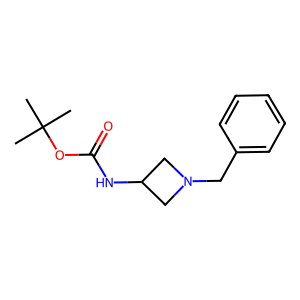
tert-Butyl (1-benzylazetidin-3-yl)carbamate
CAS No.:
1000577-78-5
M. Wt:
262.34700
M. Fa:
C15H22N2O2
InChI Key:
WWOIZPTXNMBINN-UHFFFAOYSA-N
Appearance:
Yellow Solid
Names and Identifiers of 1000577-78-5
CAS Number |
1000577-78-5 |
|---|---|
MDL Number |
MFCD09878667 |
IUPAC Name |
tert-butyl N-(1-benzylazetidin-3-yl)carbamate |
InChI |
InChI=1S/C15H22N2O2/c1-15(2,3)19-14(18)16-13-10-17(11-13)9-12-7-5-4-6-8-12/h4-8,13H,9-11H2,1-3H3,(H,16,18) |
InChIKey |
WWOIZPTXNMBINN-UHFFFAOYSA-N |
Canonical SMILES |
CC(C)(C)OC(=O)NC1CN(C1)CC2=CC=CC=C2 |
UNSPSC Code |
12352100 |
Physical and chemical properties of 1000577-78-5
Boiling Point |
369.0±31.0°C at 760 mmHg |
|---|---|
Exact Mass |
262.16800 |
LogP |
2.72430 |
Molecular Formula |
C15H22N2O2 |
Molecular Weight |
262.34700 |
PSA |
41.57000 |
Safety Information of 1000577-78-5

Applications of 1000577-78-5
tert-Butyl (1-benzylazetidin-3-yl)carbamate has potential applications in various fields:
- Pharmaceutical Development: As a building block in drug synthesis, it may lead to new therapeutics targeting neurological disorders or other diseases.
- Chemical Biology: Its derivatives could serve as probes for studying enzyme active sites or cellular processes due to their structural characteristics.
Interaction Studies of 1000577-78-5
Interaction studies involving tert-butyl (1-benzylazetidin-3-yl)carbamate focus on its binding affinity and activity against specific biological targets. These studies often employ techniques such as:
- Molecular Docking: To predict how the compound interacts with target proteins.
- In Vitro Assays: To evaluate its biological effects on cell lines or isolated enzymes.
Such studies are crucial for understanding its mechanism of action and optimizing its therapeutic potential.