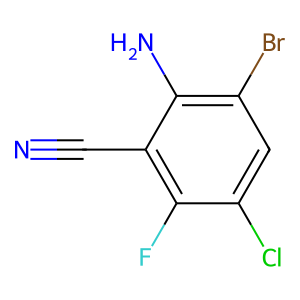
2-Amino-3-bromo-5-chloro-6-fluorobenzonitrile
CAS No.:
1000577-72-9
M. Wt:
249.467
M. Fa:
C7H3BrClFN2
InChI Key:
QDBMUGJYCLTPIJ-UHFFFAOYSA-N
Names and Identifiers of 1000577-72-9
CAS Number |
1000577-72-9 |
|---|---|
MDL Number |
MFCD09800810 |
IUPAC Name |
2-amino-3-bromo-5-chloro-6-fluorobenzonitrile |
InChI |
InChI=1S/C7H3BrClFN2/c8-4-1-5(9)6(10)3(2-11)7(4)12/h1H,12H2 |
InChIKey |
QDBMUGJYCLTPIJ-UHFFFAOYSA-N |
Canonical SMILES |
C1=C(C(=C(C(=C1Br)N)C#N)F)Cl |
UNSPSC Code |
12352100 |
Physical and chemical properties of 1000577-72-9
Boiling Point |
303.0±42.0 °C at 760 mmHg |
|---|---|
Density |
1.9±0.1 g/cm3 |
Exact Mass |
247.915207 |
Flash Point |
137.0±27.9 °C |
Index of Refraction |
1.637 |
LogP |
3.54 |
Molecular Formula |
C7H3BrClFN2 |
Molecular Weight |
249.467 |
Vapour Pressure |
0.0±0.6 mmHg at 25°C |
Safety Information of 1000577-72-9

Applications of 1000577-72-9
2-Amino-3-bromo-5-chloro-6-fluorobenzonitrile has various applications:
- Medicinal Chemistry: It is explored for its potential as a pharmaceutical agent due to its ability to interact with biological targets.
- Research: The compound serves as a tool in biochemical research to study enzyme functions and cellular processes.
Interaction Studies of 1000577-72-9
Studies on the interactions of 2-Amino-3-bromo-5-chloro-6-fluorobenzonitrile with biomolecules reveal its potential as a modulator in biochemical pathways. Its stability under laboratory conditions allows for extended studies on its effects on cellular functions and signaling pathways. Research indicates that it can influence protein phosphorylation states and gene expression patterns over time.
Biological Activity of 1000577-72-9
The biological activity of 2-Amino-3-bromo-5-chloro-6-fluorobenzonitrile is notable in several contexts:
- Enzyme Interaction: It may act as an inhibitor or activator of specific enzymes, influencing various biochemical pathways. This interaction can occur through covalent bonding, hydrogen bonding, or van der Waals forces.
- Cellular Effects: The compound impacts cell signaling pathways and gene expression, potentially altering cellular metabolism and responses. Its effects may vary based on concentration and exposure duration.
- Molecular Mechanism: The amino group facilitates hydrogen bonding with biological molecules, while the halogen substituents can participate in halogen bonding, enhancing its biological activity.