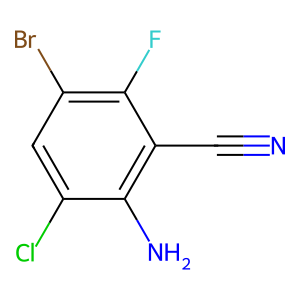
2-Amino-5-bromo-3-chloro-6-fluorobenzonitrile
CAS No.:
1000577-60-5
M. Wt:
249.467
M. Fa:
C7H3BrClFN2
InChI Key:
IRFNZWZNSTWZMB-UHFFFAOYSA-N
Appearance:
Solid
Names and Identifiers of 1000577-60-5
CAS Number |
1000577-60-5 |
|---|---|
MDL Number |
MFCD09800806 |
IUPAC Name |
2-amino-5-bromo-3-chloro-6-fluorobenzonitrile |
InChI |
InChI=1S/C7H3BrClFN2/c8-4-1-5(9)7(12)3(2-11)6(4)10/h1H,12H2 |
InChIKey |
IRFNZWZNSTWZMB-UHFFFAOYSA-N |
Canonical SMILES |
N#CC1=C(N)C(Cl)=CC(Br)=C1F |
UNSPSC Code |
12352100 |
Physical and chemical properties of 1000577-60-5
Boiling Point |
279.4±40.0 °C at 760 mmHg |
|---|---|
Density |
1.9±0.1 g/cm3 |
Exact Mass |
247.915207 |
Flash Point |
122.8±27.3 °C |
Index of Refraction |
1.637 |
LogP |
3.36 |
Molecular Formula |
C7H3BrClFN2 |
Molecular Weight |
249.467 |
Vapour Pressure |
0.0±0.6 mmHg at 25°C |
Safety Information of 1000577-60-5

Applications of 1000577-60-5
The applications of 2-amino-5-bromo-3-chloro-6-fluorobenzonitrile are diverse:
- Pharmaceutical Intermediates: It serves as an important intermediate in the synthesis of various pharmaceuticals.
- Research Chemical: Used extensively in medicinal chemistry for developing new drugs.
- Material Science: Potential applications in creating novel materials with specific electronic or optical properties.
Interaction Studies of 1000577-60-5
Interaction studies have focused on:
- Protein Binding: Investigating how this compound interacts with various proteins to understand its mechanism of action.
- Cellular Uptake: Research into how effectively it penetrates cellular membranes and its subsequent biological effects.
- Metabolic Pathways: Studies exploring how the compound is metabolized within biological systems and its potential metabolites.
Biological Activity of 1000577-60-5
Research indicates that 2-amino-5-bromo-3-chloro-6-fluorobenzonitrile exhibits notable biological activities, such as:
- Antimicrobial Properties: Preliminary studies suggest that the compound may possess antimicrobial effects against various bacterial strains.
- Anticancer Activity: Some derivatives of this compound have shown promise in inhibiting cancer cell proliferation in vitro, indicating potential as an anticancer agent.
- Enzyme Inhibition: It may act as an inhibitor for specific enzymes involved in metabolic pathways, although detailed studies are required to confirm this.