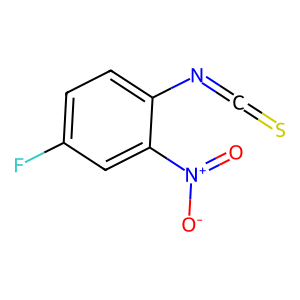
4-fluoro-1-isothiocyanato-2-nitrobenzene
Names and Identifiers of 1000576-88-4
CAS Number |
1000576-88-4 |
|---|---|
MDL Number |
MFCD09800782 |
IUPAC Name |
4-fluoro-1-isothiocyanato-2-nitrobenzene |
InChI |
InChI=1S/C7H3FN2O2S/c8-5-1-2-6(9-4-13)7(3-5)10(11)12/h1-3H |
InChIKey |
VHJCLELIUSMSDG-UHFFFAOYSA-N |
Canonical SMILES |
O=[N+]([O-])C1=CC(F)=CC=C1N=C=S |
UNSPSC Code |
12352100 |
Physical and chemical properties of 1000576-88-4
Boiling Point |
331.9±27.0 °C at 760 mmHg |
|---|---|
Density |
1.4±0.1 g/cm3 |
Exact Mass |
197.989929 |
Flash Point |
154.5±23.7 °C |
Index of Refraction |
1.613 |
LogP |
3.72 |
Molecular Formula |
C7H3FN2O2S |
Molecular Weight |
198.174 |
Vapour Pressure |
0.0±0.7 mmHg at 25°C |
Safety Information of 1000576-88-4

Applications of 1000576-88-4
4-Fluoro-2-nitrophenylisothiocyanate finds applications in various fields:
- Chemical Synthesis: It serves as a building block for synthesizing other organic compounds, particularly those involving sulfur or nitrogen functionalities.
- Biochemical Research: Its ability to label amino acids makes it useful in protein sequencing and characterization studies.
- Pharmaceutical Development: The compound's potential biological activities make it a candidate for further research in drug development.
Interaction Studies of 1000576-88-4
Interaction studies involving 4-Fluoro-2-nitrophenylisothiocyanate often focus on its reactivity with biomolecules. For instance, it has been shown to interact with amino acids through nucleophilic attack on the isothiocyanate group, which can lead to the formation of labeled amino acids useful for tracking and quantifying proteins in various assays. This property makes it an important tool in proteomics.
Biological Activity of 1000576-88-4
The biological activity of 4-Fluoro-2-nitrophenylisothiocyanate has been explored primarily in relation to its role as a reagent in biochemical assays. It can be used to label proteins and peptides, facilitating studies on protein structure and function. Additionally, compounds with isothiocyanate groups have been noted for their potential anticancer properties due to their ability to induce apoptosis in cancer cells.