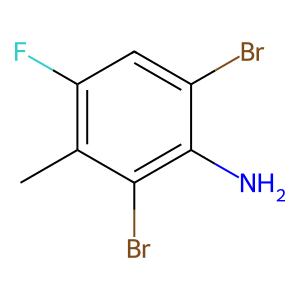
2,6-Dibromo-4-fluoro-3-methyl-phenylamine
Names and Identifiers of 1000576-72-6
CAS Number |
1000576-72-6 |
|---|---|
MDL Number |
MFCD09800776 |
IUPAC Name |
2,6-dibromo-4-fluoro-3-methylaniline |
InChI |
InChI=1S/C7H6Br2FN/c1-3-5(10)2-4(8)7(11)6(3)9/h2H,11H2,1H3 |
InChIKey |
AHLMGMWQLJMGMF-UHFFFAOYSA-N |
Canonical SMILES |
CC1=C(F)C=C(Br)C(N)=C1Br |
UNSPSC Code |
12352100 |
Physical and chemical properties of 1000576-72-6
Exact Mass |
280.88500 |
|---|---|
LogP |
3.82250 |
Molecular Formula |
C7H6Br2FN |
Molecular Weight |
282.93600 |
PSA |
26.02000 |
Safety Information of 1000576-72-6

Applications of 1000576-72-6
2,6-Dibromo-4-fluoro-3-methylaniline has potential applications in various fields:
- Agrochemicals: It may serve as an intermediate in the synthesis of pesticides or herbicides.
- Pharmaceuticals: The compound could be explored for its biological activity as a lead compound in drug development.
- Dyes and Pigments: Its unique structure may allow it to be used in dye formulations.
Interaction Studies of 1000576-72-6
Interaction studies involving 2,6-dibromo-4-fluoro-3-methylaniline typically focus on its binding affinity with biological targets such as enzymes or receptors. These studies are crucial for understanding its potential therapeutic effects and toxicity profiles. Preliminary studies suggest that similar compounds exhibit varying degrees of interaction based on structural modifications, indicating that further research is necessary to elucidate specific interactions.
Biological Activity of 1000576-72-6
Research indicates that compounds similar to 2,6-dibromo-4-fluoro-3-methylaniline exhibit significant biological activities, including antimicrobial and antifungal properties. The presence of halogen substituents often enhances these activities by increasing lipophilicity and altering the electronic properties of the molecule, potentially improving its interaction with biological targets.