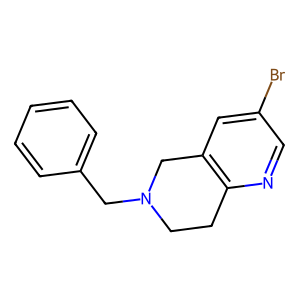
6-Benzyl-3-broMo-5,6,7,8-tetrahydro-1,6-naphthyridine
CAS No.:
1000576-67-9
M. Wt:
303.19700
M. Fa:
C15H15BrN2
InChI Key:
-
Names and Identifiers of 1000576-67-9
CAS Number |
1000576-67-9 |
|---|---|
IUPAC Name |
3-bromanyl-6-(phenylmethyl)-7,8-dihydro-5H-1,6-naphthyridine |
Canonical SMILES |
C1CN(CC2=C1N=CC(=C2)Br)CC3=CC=CC=C3 |
Physical and chemical properties of 1000576-67-9
Acidity coefficient |
5.66±0.20(Predicted) |
|---|---|
Boiling Point |
373.5±42.0 °C(Predicted) |
Density |
1.410±0.06 g/cm3(Predicted) |
Exact Mass |
302.04200 |
LogP |
3.34030 |
Molecular Formula |
C15H15BrN2 |
Molecular Weight |
303.19700 |
PSA |
16.13000 |
Storage condition |
2-8°C |
Applications of 1000576-67-9
The unique properties of 6-benzyl-3-bromo-5,6,7,8-tetrahydro-1,6-naphthyridine make it valuable in various fields:
- Pharmaceutical Development: Its potential as an anticholinesterase agent positions it as a candidate for drug development targeting neurodegenerative disorders.
- Chemical Research: It serves as an important intermediate in organic synthesis for developing more complex pharmaceutical compounds.
Interaction Studies of 1000576-67-9
Studies on the interactions of 6-benzyl-3-bromo-5,6,7,8-tetrahydro-1,6-naphthyridine with biological targets have highlighted its potential effects on neurotransmitter systems. The compound's ability to inhibit cholinesterase enzymes suggests possible applications in enhancing cognitive functions or treating cognitive decline associated with aging or disease.
Biological Activity of 1000576-67-9
Research indicates that derivatives of naphthyridine compounds exhibit significant biological activities. Specifically, 6-benzyl-3-bromo-5,6,7,8-tetrahydro-1,6-naphthyridine has been studied for its potential as:
- Anticholinesterase Agents: Similar compounds have shown effectiveness in inhibiting acetylcholinesterase and butyrylcholinesterase enzymes, which are relevant in treating neurodegenerative diseases like Alzheimer's.
- Antimicrobial Properties: Some studies suggest that naphthyridine derivatives possess antimicrobial activity against various pathogens.