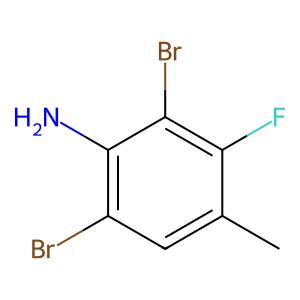
2,6-Dibromo-3-fluoro-4-methyl-phenylamine
Names and Identifiers of 1000576-48-6
CAS Number |
1000576-48-6 |
|---|---|
IUPAC Name |
2,6-bis(bromanyl)-3-fluoranyl-4-methyl-aniline |
Canonical SMILES |
CC1=CC(=C(C(=C1F)Br)N)Br |
Physical and chemical properties of 1000576-48-6
Acidity coefficient |
-0.11±0.10(Predicted) |
|---|---|
Boiling Point |
280.1±35.0 °C at 760 mmHg |
Density |
2.0±0.1 g/cm3 |
Exact Mass |
280.885101 |
Flash Point |
123.2±25.9 °C |
Index of Refraction |
1.619 |
LogP |
4.16 |
Molecular Formula |
C7H6Br2FN |
Molecular Weight |
282.936 |
Vapour Pressure |
0.0±0.6 mmHg at 25°C |
Applications of 1000576-48-6
2,6-Dibromo-3-fluoro-4-methylaniline serves multiple applications:
- Intermediate in Organic Synthesis: It is utilized in the synthesis of various pharmaceuticals and agrochemicals.
- Spectrophotometric Reagent: This compound acts as a coupling reagent in the spectrophotometric determination of carbaryl in environmental samples.
Interaction Studies of 1000576-48-6
Interaction studies involving 2,6-dibromo-3-fluoro-4-methylaniline focus on its reactivity with nucleophiles and electrophiles. Its halogen substituents significantly influence its interaction profile, making it a candidate for further exploration in drug design and material science applications. Investigations into its interactions with biological macromolecules are warranted to assess potential therapeutic uses.
Biological Activity of 1000576-48-6
While specific biological activity data for 2,6-dibromo-3-fluoro-4-methylaniline is limited, compounds with similar structures often exhibit antimicrobial and antifungal properties. The presence of halogens (bromine and fluorine) typically enhances biological activity by increasing lipophilicity and altering metabolic pathways. Further studies are necessary to elucidate its specific biological effects.