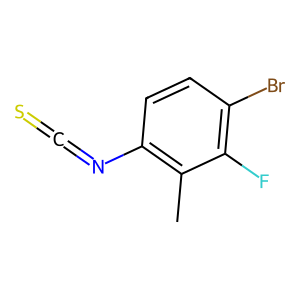
1-bromo-2-fluoro-4-isothiocyanato-3-methylbenzene
Names and Identifiers of 1000576-39-5
CAS Number |
1000576-39-5 |
|---|---|
MDL Number |
MFCD09800766 |
IUPAC Name |
1-bromo-2-fluoro-4-isothiocyanato-3-methylbenzene |
InChI |
InChI=1S/C8H5BrFNS/c1-5-7(11-4-12)3-2-6(9)8(5)10/h2-3H,1H3 |
InChIKey |
ZYTVGZLBQPJEEB-UHFFFAOYSA-N |
Canonical SMILES |
CC1=C(N=C=S)C=CC(Br)=C1F |
UNSPSC Code |
12352100 |
Physical and chemical properties of 1000576-39-5
Exact Mass |
244.93100 |
|---|---|
LogP |
3.63090 |
Molecular Formula |
C8H5BrFNS |
Molecular Weight |
246.09900 |
PSA |
44.45000 |
Safety Information of 1000576-39-5

Applications of 1000576-39-5
4-Bromo-3-fluoro-2-methylphenylisothiocyanate finds applications in various fields:
- Organic Synthesis: It serves as an intermediate in the synthesis of pharmaceuticals and agrochemicals.
- Biological Research: Its potential anticancer properties make it a candidate for further studies in drug development.
- Chemical Analysis: This compound can be used as a reagent in analytical chemistry for detecting amines and other functional groups.
These applications underscore its significance in both industrial and research settings.
Interaction Studies of 1000576-39-5
Studies on the interactions of 4-Bromo-3-fluoro-2-methylphenylisothiocyanate with biological molecules are essential for understanding its mechanism of action. Preliminary research suggests that it may interact with proteins involved in cell signaling pathways, potentially leading to altered cellular responses. Further studies using techniques such as surface plasmon resonance or nuclear magnetic resonance could provide insights into these interactions and help elucidate its biological effects.
Biological Activity of 1000576-39-5
4-Bromo-3-fluoro-2-methylphenylisothiocyanate exhibits notable biological activities. Compounds containing isothiocyanate groups are often studied for their potential anticancer properties. Research has indicated that such compounds may induce apoptosis in cancer cells and exhibit antimicrobial activity. The specific biological mechanisms of 4-Bromo-3-fluoro-2-methylphenylisothiocyanate are still under investigation, but preliminary studies suggest it may interact with cellular pathways involved in cell growth and apoptosis.