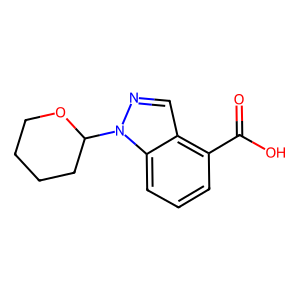
1-(Tetrahydro-2H-pyran-2-yl)-1H-indazole-4-carboxylic acid
Names and Identifiers of 1000576-23-7
CAS Number |
1000576-23-7 |
|---|---|
EC Number |
811-912-0 |
IUPAC Name |
1-(oxan-2-yl)indazole-4-carboxylic acid |
InChI |
InChI=1S/C13H14N2O3/c16-13(17)9-4-3-5-11-10(9)8-14-15(11)12-6-1-2-7-18-12/h3-5,8,12H,1-2,6-7H2,(H,16,17) |
InChIKey |
SFBZBDJWQOVUGI-UHFFFAOYSA-N |
Canonical SMILES |
C1CCOC(C1)N2C3=CC=CC(=C3C=N2)C(=O)O |
Physical and chemical properties of 1000576-23-7
Exact Mass |
246.10000 |
|---|---|
LogP |
2.43360 |
Molecular Formula |
C13H14N2O3 |
Molecular Weight |
246.26200 |
PSA |
64.35000 |
Safety Information of 1000576-23-7

Applications of 1000576-23-7
The applications of 1-(Tetrahydro-2H-pyran-2-yl)-1H-indazole-4-carboxylic acid span several fields:
- Pharmaceutical Development: Its potential biological activities make it a candidate for drug development targeting various diseases.
- Chemical Research: As a building block in organic synthesis, it can be utilized to create more complex molecules.
- Agricultural Chemistry: Investigations into its efficacy as a pesticide or herbicide are ongoing due to its structural similarities with known agrochemicals.
These applications reflect its significance in both medicinal chemistry and industrial applications.
Interaction Studies of 1000576-23-7
Interaction studies involving 1-(Tetrahydro-2H-pyran-2-yl)-1H-indazole-4-carboxylic acid focus on its binding affinity to biological targets. Preliminary data suggest:
- Protein Binding: Investigations using techniques such as surface plasmon resonance may reveal how this compound interacts with specific proteins involved in disease pathways.
- Enzyme Inhibition: Studies assessing its effects on enzyme activity could provide insights into its mechanism of action as a therapeutic agent.
Understanding these interactions is crucial for predicting pharmacokinetics and optimizing therapeutic efficacy.
Biological Activity of 1000576-23-7
Research into the biological activity of 1-(Tetrahydro-2H-pyran-2-yl)-1H-indazole-4-carboxylic acid suggests potential pharmacological applications. Compounds with indazole structures are often investigated for their anti-inflammatory, analgesic, and anti-cancer properties. Preliminary studies indicate that this compound may exhibit:
- Antimicrobial Activity: Potential efficacy against various bacterial strains.
- Cytotoxic Effects: Inhibition of cancer cell proliferation in vitro.
- Anti-inflammatory Properties: Modulation of inflammatory pathways.
Further research is necessary to fully elucidate its mechanisms and therapeutic potential.
Physical sample testing spectrum (NMR) of 1000576-23-7
