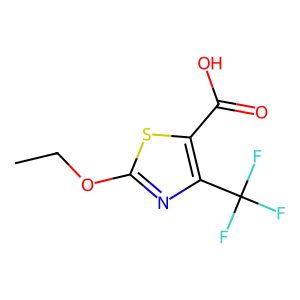
2-Ethoxy-4-(trifluoromethyl)-1,3-thiazole-5-carboxylic acid
CAS No.:
1000575-29-0
M. Wt:
241.19
M. Fa:
C7H6F3NO3S
InChI Key:
KSDCEAAVFJOFHJ-UHFFFAOYSA-N
Names and Identifiers of 1000575-29-0
CAS Number |
1000575-29-0 |
|---|---|
MDL Number |
MFCD09800750 |
IUPAC Name |
2-ethoxy-4-(trifluoromethyl)-1,3-thiazole-5-carboxylic acid |
InChI |
InChI=1S/C7H6F3NO3S/c1-2-14-6-11-4(7(8,9)10)3(15-6)5(12)13/h2H2,1H3,(H,12,13) |
InChIKey |
KSDCEAAVFJOFHJ-UHFFFAOYSA-N |
Canonical SMILES |
CCOC1=NC(C(F)(F)F)=C(C(=O)O)S1 |
UNSPSC Code |
12352100 |
Physical and chemical properties of 1000575-29-0
Molecular Formula |
C7H6F3NO3S |
|---|---|
Molecular Weight |
241.19 |
Safety Information of 1000575-29-0

Applications of 1000575-29-0
The compound has several notable applications:
- Agricultural Chemicals: Due to its antifungal and antibacterial properties, it can be used in developing agricultural fungicides and bactericides.
- Pharmaceuticals: Its biological activity makes it a candidate for drug development against viral and bacterial infections.
- Chemical Research: Utilized in proteomics research and as a building block for synthesizing other complex organic molecules.
Interaction Studies of 1000575-29-0
Interaction studies involving 2-Ethoxy-4-(trifluoromethyl)-1,3-thiazole-5-carboxylic acid focus on its binding affinities with various biological targets. For instance:
- Enzyme Inhibition: Studies have shown that certain thiazole derivatives can inhibit specific enzymes involved in pathogenic processes.
- Molecular Docking Studies: Computational studies suggest strong binding interactions with targets like kinases, which may lead to further exploration in drug design.
Biological Activity of 1000575-29-0
Research indicates that derivatives of thiazole compounds exhibit significant biological activities:
- Antiviral Activity: Compounds similar to 2-Ethoxy-4-(trifluoromethyl)-1,3-thiazole-5-carboxylic acid have shown efficacy against viruses such as Tobacco Mosaic Virus, suggesting potential applications in antiviral therapies.
- Antifungal Properties: Studies have reported fungicidal activities, indicating that these compounds could be useful in agricultural applications.
- Antibacterial Effects: Several derivatives have demonstrated antibacterial properties, suggesting their potential as new antibacterial agents.