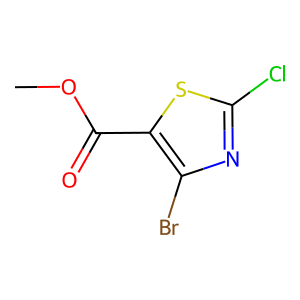
methyl 4-bromo-2-chloro-1,3-thiazole-5-carboxylate
Names and Identifiers of 1000575-16-5
CAS Number |
1000575-16-5 |
|---|---|
MDL Number |
MFCD09878034 |
IUPAC Name |
methyl 4-bromo-2-chloro-1,3-thiazole-5-carboxylate |
InChI |
InChI=1S/C5H3BrClNO2S/c1-10-4(9)2-3(6)8-5(7)11-2/h1H3 |
InChIKey |
IIJWBQWNNFDNAV-UHFFFAOYSA-N |
Canonical SMILES |
COC(=O)C1=C(Br)N=C(Cl)S1 |
UNSPSC Code |
12352100 |
Physical and chemical properties of 1000575-16-5
Boiling Point |
323.2±45.0 °C at 760 mmHg |
|---|---|
Density |
1.9±0.1 g/cm3 |
Exact Mass |
254.875626 |
Flash Point |
149.3±28.7 °C |
Index of Refraction |
1.597 |
LogP |
1.32 |
Molecular Formula |
C5H3BrClNO2S |
Molecular Weight |
256.505 |
Vapour Pressure |
0.0±0.7 mmHg at 25°C |
Safety Information of 1000575-16-5

Applications of 1000575-16-5
Methyl 4-Bromo-2-chlorothiazole-5-carboxylate finds applications in several fields:
- Pharmaceutical Research: As a potential lead compound for drug discovery targeting various diseases.
- Agricultural Chemistry: Used in developing pesticides or herbicides due to its biological activity against pests.
- Biochemical Studies: Employed in proteomics research to study protein interactions and functions.
Its unique structure allows for modifications that can enhance its efficacy and specificity for various applications.
Interaction Studies of 1000575-16-5
Interaction studies involving methyl 4-Bromo-2-chlorothiazole-5-carboxylate focus on its binding affinity with biological macromolecules:
- Protein Binding Studies: Investigating how this compound interacts with proteins can provide insights into its mechanism of action.
- Enzyme Inhibition Assays: Assessing its ability to inhibit specific enzymes helps determine its potential therapeutic applications.
- Cellular Uptake Studies: Understanding how this compound enters cells can inform its bioavailability and efficacy as a drug candidate.
Such studies are essential for evaluating the pharmacokinetics and pharmacodynamics of the compound.
Biological Activity of 1000575-16-5
The biological activity of methyl 4-Bromo-2-chlorothiazole-5-carboxylate has been the subject of investigation due to its potential as a bioactive agent. Preliminary studies suggest that it may possess:
- Antimicrobial Properties: Similar compounds in the thiazole family have demonstrated efficacy against various bacterial strains.
- Anticancer Activity: Some derivatives have shown promise in inhibiting cancer cell proliferation.
- Enzyme Inhibition: The compound may interact with specific enzymes, potentially serving as a lead for drug development targeting metabolic pathways.
Further research is necessary to elucidate the specific mechanisms of action and therapeutic potential of this compound.