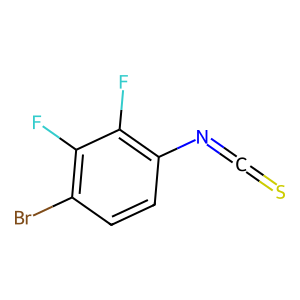
4-Bromo-2,3-difluorophenyl isothiocyanate
Names and Identifiers of 1000574-53-7
CAS Number |
1000574-53-7 |
|---|---|
MDL Number |
MFCD09878202 |
IUPAC Name |
1-bromo-2,3-difluoro-4-isothiocyanatobenzene |
InChI |
InChI=1S/C7H2BrF2NS/c8-4-1-2-5(11-3-12)7(10)6(4)9/h1-2H |
InChIKey |
NVMLTPSSTQHADF-UHFFFAOYSA-N |
Canonical SMILES |
C1=CC(=C(C(=C1N=C=S)F)F)Br |
UNSPSC Code |
12352100 |
Physical and chemical properties of 1000574-53-7
Boiling Point |
282.1±40.0 °C at 760 mmHg |
|---|---|
Density |
1.7±0.1 g/cm3 |
Exact Mass |
248.905930 |
Flash Point |
124.4±27.3 °C |
Index of Refraction |
1.588 |
LogP |
4.01 |
Molecular Formula |
C7H2BrF2NS |
Molecular Weight |
250.063 |
Vapour Pressure |
0.0±0.6 mmHg at 25°C |
Safety Information of 1000574-53-7

Applications of 1000574-53-7
4-Bromo-2,3-difluorophenyl isothiocyanate finds applications across various fields:
- Medicinal Chemistry: Used in drug development due to its potential anti-cancer and antimicrobial properties.
- Chemical Biology: Serves as a tool for studying protein interactions and enzyme activity.
- Agricultural Chemistry: Investigated for use as a pesticide or herbicide due to its biological activity against pests and pathogens.
Interaction Studies of 1000574-53-7
Interaction studies involving 4-bromo-2,3-difluorophenyl isothiocyanate have shown that it can interact with various biological macromolecules such as proteins and nucleic acids. These interactions may lead to changes in enzyme activity or gene expression, which are crucial for understanding its potential therapeutic effects. Research indicates that compounds with similar structures can modulate pathways involved in cell growth and apoptosis.
Biological Activity of 1000574-53-7
4-Bromo-2,3-difluorophenyl isothiocyanate exhibits significant biological activity, particularly in the field of medicinal chemistry. It has been studied for its potential anti-cancer properties, as compounds containing isothiocyanate groups are known to induce apoptosis in cancer cells. Furthermore, this compound may exhibit antimicrobial properties, making it a candidate for further research in pharmacology.