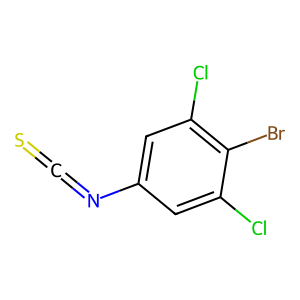
2-bromo-1,3-dichloro-5-isothiocyanatobenzene
Names and Identifiers of 1000574-23-1
CAS Number |
1000574-23-1 |
|---|---|
MDL Number |
MFCD09878194 |
IUPAC Name |
2-bromo-1,3-dichloro-5-isothiocyanatobenzene |
InChI |
InChI=1S/C7H2BrCl2NS/c8-7-5(9)1-4(11-3-12)2-6(7)10/h1-2H |
InChIKey |
LPPRFSRJFKEVIK-UHFFFAOYSA-N |
Canonical SMILES |
S=C=NC1=CC(Cl)=C(Br)C(Cl)=C1 |
UNSPSC Code |
12352100 |
Physical and chemical properties of 1000574-23-1
Exact Mass |
280.84700 |
|---|---|
LogP |
4.49020 |
Molecular Formula |
C7H2BrCl2NS |
Molecular Weight |
282.97200 |
PSA |
44.45000 |
Safety Information of 1000574-23-1

Applications of 1000574-23-1
4-Bromo-3,5-dichlorophenylisothiocyanate has several applications across different fields:
- Pharmaceutical Research: Its potential anti-cancer properties make it a candidate for further investigation in drug development.
- Biochemical Studies: It is used as a biochemical reagent in proteomics and enzyme inhibition studies.
- Agricultural Chemistry: Due to its biological activity, it may be explored for use in pest control formulations.
These applications underscore its significance in both academic research and industrial settings.
Interaction Studies of 1000574-23-1
Interaction studies involving 4-bromo-3,5-dichlorophenylisothiocyanate focus on its ability to interact with various biomolecules:
- Protein Binding: Research has shown that this compound can bind to specific proteins involved in cellular signaling pathways, potentially altering their function.
- Enzyme Inhibition: It has been evaluated for its inhibitory effects on enzymes linked to cancer metabolism and inflammation.
These studies are crucial for understanding the mechanisms through which this compound exerts its biological effects.
Biological Activity of 1000574-23-1
The biological activity of 4-bromo-3,5-dichlorophenylisothiocyanate has been explored primarily in relation to its potential anti-cancer properties. Isothiocyanates are known for their ability to induce apoptosis in cancer cells and inhibit tumor growth through various mechanisms, including:
- Inhibition of Cell Proliferation: This compound can disrupt cell cycle progression in cancer cells.
- Antioxidant Activity: It may exert protective effects against oxidative stress by modulating antioxidant enzyme activities.
- Modulation of Signaling Pathways: 4-bromo-3,5-dichlorophenylisothiocyanate can influence signaling pathways involved in inflammation and cancer progression.
Research indicates that compounds with similar structures often exhibit significant anti-inflammatory and antimicrobial properties, suggesting a wide range of potential therapeutic applications.