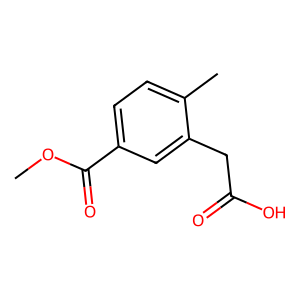
2-(5-methoxycarbonyl-2-methylphenyl)acetic acid
Names and Identifiers of 1000566-21-1
CAS Number |
1000566-21-1 |
|---|---|
MDL Number |
MFCD09925055 |
IUPAC Name |
2-[5-(methoxycarbonyl)-2-methylphenyl]acetic acid |
InChI |
InChI=1S/C11H12O4/c1-7-3-4-8(11(14)15-2)5-9(7)6-10(12)13/h3-5H,6H2,1-2H3,(H,12,13) |
InChIKey |
KZGVJCJKOBSZMW-UHFFFAOYSA-N |
Canonical SMILES |
COC(=O)C1=CC=C(C)C(CC(=O)O)=C1 |
UNSPSC Code |
12352100 |
Physical and chemical properties of 1000566-21-1
Exact Mass |
208.07400 |
|---|---|
H Bond Acceptors |
3 |
H Bond Donors |
1 |
LogP |
1.40870 |
Molecular Formula |
C11H12O4 |
Molecular Weight |
208.21100 |
PSA |
63.60000 |
Safety Information of 1000566-21-1

Applications of 1000566-21-1
2-(5-(Methoxycarbonyl)-2-methylphenyl)acetic acid has diverse applications across several fields:
- Chemistry: Serves as an intermediate in the synthesis of more complex organic molecules.
- Biology: Investigated for its potential biological activity and interactions with biomolecules.
- Medicine: Explored for its therapeutic properties and as a precursor for drug development.
- Industry: Utilized in producing specialty chemicals and materials.
These applications highlight its significance in both academic research and industrial settings.
Interaction Studies of 1000566-21-1
The interaction studies of 2-(5-(Methoxycarbonyl)-2-methylphenyl)acetic acid focus on its binding affinity and inhibitory effects on specific enzymes or receptors. Such studies are crucial for understanding its potential therapeutic effects and mechanisms of action within biological systems. The compound's unique structural features may influence its interactions, making it a subject of interest in pharmacological research.
Biological Activity of 1000566-21-1
Research indicates that 2-(5-(Methoxycarbonyl)-2-methylphenyl)acetic acid exhibits potential biological activity. The mechanism of action involves interactions with specific molecular targets, such as enzymes or receptors. The methoxycarbonyl group can participate in hydrogen bonding, influencing the activity of these biological targets. Studies have suggested that the compound may have implications in enzyme inhibition and modulation of metabolic pathways, making it a candidate for further pharmacological investigation.