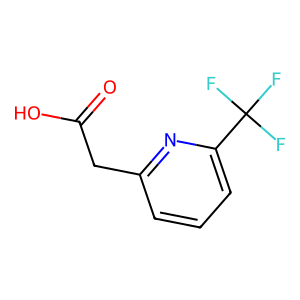
2-(6-(Trifluoromethyl)pyridin-2-yl)acetic acid
Names and Identifiers of 1000565-32-1
CAS Number |
1000565-32-1 |
|---|---|
MDL Number |
MFCD09924928 |
IUPAC Name |
2-[6-(trifluoromethyl)pyridin-2-yl]acetic acid |
InChI |
InChI=1S/C8H6F3NO2/c9-8(10,11)6-3-1-2-5(12-6)4-7(13)14/h1-3H,4H2,(H,13,14) |
InChIKey |
WRPOGLABYJEOEX-UHFFFAOYSA-N |
Canonical SMILES |
C1=CC(=NC(=C1)C(F)(F)F)CC(=O)O |
UNSPSC Code |
12352100 |
Physical and chemical properties of 1000565-32-1
Exact Mass |
205.03500 |
|---|---|
LogP |
1.72750 |
Molecular Formula |
C8H6F3NO2 |
Molecular Weight |
205.13400 |
PSA |
50.19000 |
Storage condition |
Keep in dark place,Inert atmosphere,Store in freezer, under -20°C |
Safety Information of 1000565-32-1

Applications of 1000565-32-1
The primary applications of 2-(6-(Trifluoromethyl)pyridin-2-yl)acetic acid include:
- Pharmaceutical Development: As an intermediate in drug synthesis.
- Agricultural Chemistry: Potential use in developing agrochemicals due to its biological activity.
- Material Science: Used in creating novel materials with specific functional properties.
Interaction Studies of 1000565-32-1
Interaction studies have shown that 2-(6-(Trifluoromethyl)pyridin-2-yl)acetic acid can interact with various biological targets, making it a candidate for further pharmacological studies. Its interactions often depend on the presence of the trifluoromethyl group, which influences binding affinity and selectivity towards specific receptors or enzymes.
Biological Activity of 1000565-32-1
Research indicates that 2-(6-(Trifluoromethyl)pyridin-2-yl)acetic acid exhibits biological activities that may be beneficial in pharmacological applications. It has been noted for its potential as a precursor in the synthesis of microbicides and other biologically active compounds. The trifluoromethyl group is known to enhance the lipophilicity and metabolic stability of compounds, potentially increasing their efficacy as drugs.