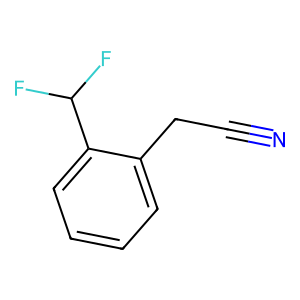
2-(2-(Difluoromethyl)phenyl)acetonitrile
Names and Identifiers of 1000556-48-8
CAS Number |
1000556-48-8 |
|---|---|
IUPAC Name |
2-[2-(difluoromethyl)phenyl]acetonitrile |
InChI |
InChI=1S/C9H7F2N/c10-9(11)8-4-2-1-3-7(8)5-6-12/h1-4,9H,5H2 |
InChIKey |
BZPZUXSCXCFTBO-UHFFFAOYSA-N |
Canonical SMILES |
C1=CC=C(C(=C1)CC#N)C(F)F |
Physical and chemical properties of 1000556-48-8
Boiling Point |
240.1±35.0 °C at 760 mmHg |
|---|---|
Density |
1.2±0.1 g/cm3 |
Exact Mass |
167.054657 |
Flash Point |
99.0±25.9 °C |
Index of Refraction |
1.482 |
LogP |
2.06 |
Molecular Formula |
C9H7F2N |
Molecular Weight |
167.16 |
Vapour Pressure |
0.0±0.5 mmHg at 25°C |
Applications of 1000556-48-8
The unique properties of 2-(2-(Difluoromethyl)phenyl)acetonitrile make it valuable in various fields:
- Medicinal Chemistry: Its potential as a drug candidate due to its biological activity.
- Material Science: Utilized in the development of advanced materials with specific electronic or thermal properties.
- Agricultural Chemistry: Investigated for use in agrochemicals due to its ability to modify biological pathways in pests.
Interaction Studies of 1000556-48-8
Interaction studies involving 2-(2-(Difluoromethyl)phenyl)acetonitrile have focused on its binding affinity with various biological targets, particularly enzymes involved in drug metabolism. Research indicates that it may act as an inhibitor for certain cytochrome P450 enzymes, which play a critical role in drug metabolism and detoxification processes. Understanding these interactions is crucial for evaluating its safety and efficacy as a pharmaceutical agent.
Biological Activity of 1000556-48-8
Compounds containing difluoromethyl groups often exhibit significant biological activities due to their ability to modulate lipophilicity and hydrogen bonding capabilities. Specifically, 2-(2-(Difluoromethyl)phenyl)acetonitrile has been studied for its potential as a pharmaceutical agent. Preliminary studies suggest that it may inhibit certain cytochrome P450 enzymes, indicating a potential role in drug metabolism modulation.