![structure of (3E)-3-(hydroxyimino)-4,7,7-trimethylbicyclo[2.2.1]heptane-1-carboxylic acid](https://molwiki.oss-cn-hongkong.aliyuncs.com/structure/50/100055-50-3.svg)
(3E)-3-(hydroxyimino)-4,7,7-trimethylbicyclo[2.2.1]heptane-1-carboxylic acid
CAS No.:
100055-50-3
M. Wt:
211.25800
M. Fa:
C11H17NO3
InChI Key:
NSRBNLPONXTVQG-KPKJPENVSA-N
Names and Identifiers of 100055-50-3
CAS Number |
100055-50-3 |
|---|---|
MDL Number |
MFCD03659904 |
IUPAC Name |
(3E)-3-hydroxyimino-4,7,7-trimethylbicyclo[2.2.1]heptane-1-carboxylic acid |
InChI |
InChI=1S/C11H17NO3/c1-9(2)10(3)4-5-11(9,8(13)14)6-7(10)12-15/h15H,4-6H2,1-3H3,(H,13,14)/b12-7+ |
InChIKey |
NSRBNLPONXTVQG-KPKJPENVSA-N |
Canonical SMILES |
CC1(C2(CCC1(CC2=NO)C(=O)O)C)C |
Isomeric SMILES |
CC1(C\2(CCC1(C/C2=N\O)C(=O)O)C)C |
UNSPSC Code |
12352100 |
Physical and chemical properties of 100055-50-3
Acidity coefficient |
4.39±0.60(Predicted) |
|---|---|
Boiling Point |
354.2±25.0 °C(Predicted) |
Density |
1.29±0.1 g/cm3(Predicted) |
Exact Mass |
211.12100 |
LogP |
2.11760 |
Molecular Formula |
C11H17NO3 |
Molecular Weight |
211.25800 |
PSA |
69.89000 |
Safety Information of 100055-50-3

Applications of 100055-50-3
The applications of (3E)-3-(hydroxyimino)-4,7,7-trimethylbicyclo[2.2.1]heptane-1-carboxylic acid span various fields:
- Pharmaceuticals: Due to its potential biological activities, it may serve as a lead compound in drug discovery.
- Agriculture: Its antimicrobial properties could be harnessed for developing plant protection agents.
- Material Science: The unique structural characteristics may allow for incorporation into polymer matrices for enhanced material properties.
Interaction Studies of 100055-50-3
Interaction studies focus on how (3E)-3-(hydroxyimino)-4,7,7-trimethylbicyclo[2.2.1]heptane-1-carboxylic acid interacts with biological targets:
- Binding Affinity Assessments: Investigating how effectively the compound binds to specific enzymes or receptors can provide insights into its mechanism of action.
- In Vitro Assays: Evaluating the compound's effects on cell viability and metabolic activity helps determine its therapeutic potential.
- Molecular Docking Studies: Computational approaches can predict binding interactions and affinities with various biological targets.
Biological Activity of 100055-50-3
Research indicates that compounds with similar structural features to (3E)-3-(hydroxyimino)-4,7,7-trimethylbicyclo[2.2.1]heptane-1-carboxylic acid exhibit diverse biological activities, including:
- Antimicrobial Properties: Compounds with hydroxyimino functionalities have shown potential as antimicrobial agents against various pathogens.
- Antioxidant Activity: The presence of hydroxyl and imino groups may contribute to antioxidant properties by scavenging free radicals.
- Enzyme Inhibition: The compound may interact with specific enzymes, influencing metabolic pathways crucial for cellular function.
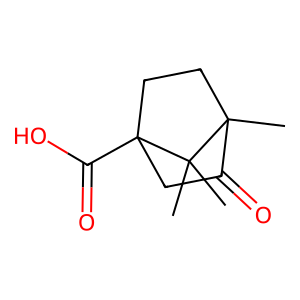 Cas:6703-31-7

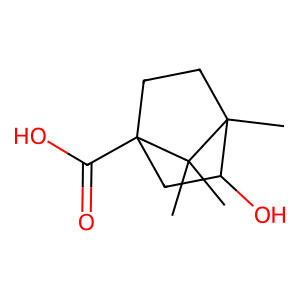 Cas:93257-31-9
 Cas:93088-64-3