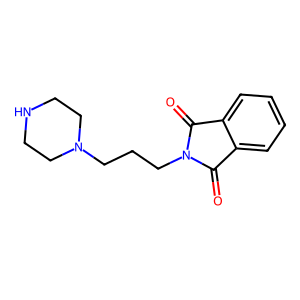
2-(3-(Piperazin-1-yl)propyl)isoindoline-1,3-dione
CAS No.:
1000547-80-7
M. Wt:
273.33
M. Fa:
C15H19N3O2
InChI Key:
DRHBTIYXNWOQDF-UHFFFAOYSA-N
Names and Identifiers of 1000547-80-7
CAS Number |
1000547-80-7 |
|---|---|
IUPAC Name |
2-(3-piperazin-1-ylpropyl)isoindole-1,3-dione |
InChI |
InChI=1S/C15H19N3O2/c19-14-12-4-1-2-5-13(12)15(20)18(14)9-3-8-17-10-6-16-7-11-17/h1-2,4-5,16H,3,6-11H2 |
InChIKey |
DRHBTIYXNWOQDF-UHFFFAOYSA-N |
Canonical SMILES |
C1CN(CCN1)CCCN2C(=O)C3=CC=CC=C3C2=O |
Physical and chemical properties of 1000547-80-7
Molecular Formula |
C15H19N3O2 |
|---|---|
Molecular Weight |
273.33 |
Applications of 1000547-80-7
The applications of 2-(3-(Piperazin-1-yl)propyl)isoindoline-1,3-dione are diverse due to its biological properties:
- Pharmaceutical Development: It serves as a lead compound in drug discovery for treating neurological disorders and infections.
- Research Tool: The compound is used in biochemical research to study enzyme interactions and cellular signaling pathways.
- Potential Anticancer Agent: Its ability to inhibit cancer cell growth positions it as a candidate for further development in oncology.
Interaction Studies of 1000547-80-7
Interaction studies have revealed that 2-(3-(Piperazin-1-yl)propyl)isoindoline-1,3-dione can bind effectively to various biological targets:
- Acetylcholinesterase: Binding studies show that this compound interacts with key residues in the active site of acetylcholinesterase, indicating potential as an inhibitor for Alzheimer’s disease treatment.
- Butyrylcholinesterase: Similar interactions have been observed with butyrylcholinesterase, suggesting its utility in modulating cholinergic signaling pathways.
These interactions are crucial for understanding the pharmacodynamics of the compound and its derivatives.
Biological Activity of 1000547-80-7
2-(3-(Piperazin-1-yl)propyl)isoindoline-1,3-dione exhibits significant biological activities. Studies have shown that isoindoline derivatives can interact with various biological targets, including enzymes involved in neurotransmission and cell proliferation. Notably:
- Enzyme Inhibition: This compound has been reported to interact with acetylcholinesterase and butyrylcholinesterase, showing potential as a therapeutic agent for neurodegenerative diseases.
- Antimicrobial Activity: Isoindoline derivatives have demonstrated antibacterial and antifungal properties, making them candidates for developing new antimicrobial agents.
- Anticancer Potential: Some studies indicate that derivatives of isoindoline can inhibit cancer cell growth through various mechanisms, including apoptosis induction and cell cycle arrest.