
2-(3,7-dimethyloctyl)isoindole-1,3-dione
Names and Identifiers of 1000546-87-1
CAS Number |
1000546-87-1 |
|---|---|
MDL Number |
MFCD09923424 |
IUPAC Name |
2-(3,7-dimethyloctyl)isoindole-1,3-dione |
InChI |
InChI=1S/C18H25NO2/c1-13(2)7-6-8-14(3)11-12-19-17(20)15-9-4-5-10-16(15)18(19)21/h4-5,9-10,13-14H,6-8,11-12H2,1-3H3 |
InChIKey |
VEKTZAJCKACLFH-UHFFFAOYSA-N |
Canonical SMILES |
CC(C)CCCC(C)CCN1C(=O)C2=CC=CC=C2C1=O |
UNSPSC Code |
12352100 |
Physical and chemical properties of 1000546-87-1
Exact Mass |
287.18900 |
|---|---|
LogP |
4.07300 |
Molecular Formula |
C18H25NO2 |
Molecular Weight |
287.39700 |
PSA |
37.38000 |
Safety Information of 1000546-87-1

Applications of 1000546-87-1
2-(3,7-Dimethyloctyl)isoindoline-1,3-dione has potential applications in various fields:
- Pharmaceuticals: Due to its biological activity, it may serve as a lead compound for developing new antimicrobial or anticancer drugs.
- Material Science: Its unique structure may allow it to be used in creating novel materials with specific properties.
- Chemical Research: As a versatile building block in organic synthesis, it can be utilized for further chemical modifications.
Interaction Studies of 1000546-87-1
Studies on the interaction of 2-(3,7-Dimethyloctyl)isoindoline-1,3-dione with biological targets are crucial for understanding its mechanism of action. Computational studies such as molecular docking have been employed to predict how this compound interacts with specific enzymes or receptors involved in disease pathways. These studies help elucidate its potential therapeutic effects and guide future drug development .
Biological Activity of 1000546-87-1
Research indicates that isoindoline derivatives exhibit significant biological activities. Specifically, 2-(3,7-Dimethyloctyl)isoindoline-1,3-dione has been studied for its potential antimicrobial and anticancer properties. The compound's structure may enhance its interaction with biological targets, leading to various pharmacological effects. For instance, related isoindoline derivatives have shown promising results against microbial strains and cancer cell lines .
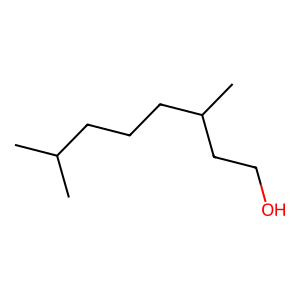 Cas:68680-98-8

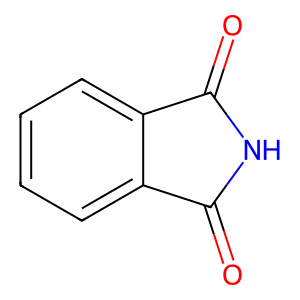 Cas:85-41-6

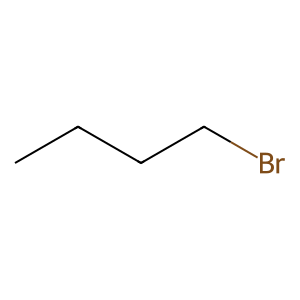 Cas:109-65-9