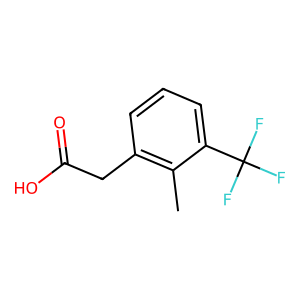
2-Methyl-3-(trifluoromethyl)phenylacetic acid
Names and Identifiers of 1000546-18-8
CAS Number |
1000546-18-8 |
|---|---|
MDL Number |
MFCD09832279 |
IUPAC Name |
2-[2-methyl-3-(trifluoromethyl)phenyl]acetic acid |
InChI |
InChI=1S/C10H9F3O2/c1-6-7(5-9(14)15)3-2-4-8(6)10(11,12)13/h2-4H,5H2,1H3,(H,14,15) |
InChIKey |
FQVYJURFBWJJPW-UHFFFAOYSA-N |
Canonical SMILES |
CC1=C(C=CC=C1C(F)(F)F)CC(=O)O |
UNSPSC Code |
12352100 |
Physical and chemical properties of 1000546-18-8
Boiling Point |
269.2±35.0 °C at 760 mmHg |
|---|---|
Density |
1.3±0.1 g/cm3 |
Exact Mass |
218.055466 |
Flash Point |
116.6±25.9 °C |
Index of Refraction |
1.478 |
LogP |
2.54 |
Melting Point |
105-108℃ |
Molecular Formula |
C10H9F3O2 |
Molecular Weight |
218.173 |
Vapour Pressure |
0.0±0.6 mmHg at 25°C |
Safety Information of 1000546-18-8

Applications of 1000546-18-8
The applications of 2-Methyl-3-(trifluoromethyl)phenylacetic acid are diverse:
- Pharmaceuticals: Used as an intermediate in the synthesis of various therapeutic agents.
- Agricultural Chemicals: Potentially useful in developing agrochemicals due to its unique properties.
- Research Tool: Employed in studies investigating the structure-activity relationship of phenylacetic acids.
Interaction Studies of 1000546-18-8
Interaction studies have shown that 2-Methyl-3-(trifluoromethyl)phenylacetic acid can bind to specific receptors or enzymes, influencing biological pathways. For instance, its interactions with neurotransmitter systems may contribute to its pharmacological effects, although detailed mechanisms remain an area of active research.
Biological Activity of 1000546-18-8
Research indicates that 2-Methyl-3-(trifluoromethyl)phenylacetic acid exhibits notable biological activities. It has been studied for its potential effects on the central nervous system and may have applications in treating conditions such as obesity and anxiety disorders. Its structural similarity to other bioactive compounds suggests that it could interact with various biological targets, although specific mechanisms are still under investigation.