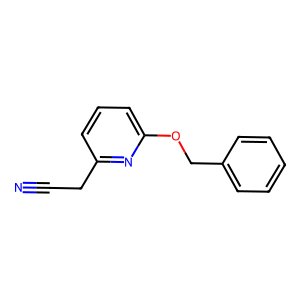
2-(6-(Benzyloxy)pyridin-2-yl)acetonitrile
CAS No.:
1000545-89-0
M. Wt:
224.25800
M. Fa:
C14H12N2O
InChI Key:
IKRVODIMXPPYHC-UHFFFAOYSA-N
Names and Identifiers of 1000545-89-0
CAS Number |
1000545-89-0 |
|---|---|
IUPAC Name |
2-(6-phenylmethoxypyridin-2-yl)acetonitrile |
InChI |
InChI=1S/C14H12N2O/c15-10-9-13-7-4-8-14(16-13)17-11-12-5-2-1-3-6-12/h1-8H,9,11H2 |
InChIKey |
IKRVODIMXPPYHC-UHFFFAOYSA-N |
Canonical SMILES |
C1=CC=C(C=C1)COC2=CC=CC(=N2)CC#N |
Physical and chemical properties of 1000545-89-0
Exact Mass |
224.09500 |
|---|---|
LogP |
2.72668 |
Molecular Formula |
C14H12N2O |
Molecular Weight |
224.25800 |
PSA |
45.91000 |
Applications of 1000545-89-0
The unique structure of 2-(6-(Benzyloxy)pyridin-2-yl)acetonitrile lends itself to various applications:
- Pharmaceutical Development: Due to its potential biological activities, it may serve as a lead compound in drug discovery for antimicrobial or anticancer agents.
- Chemical Probes: It can be used as a chemical probe in biological studies to elucidate mechanisms of action for certain pathways.
- Material Science: Its properties may also find applications in developing new materials with specific electronic or optical characteristics.
Interaction Studies of 1000545-89-0
Interaction studies involving 2-(6-(Benzyloxy)pyridin-2-yl)acetonitrile are essential for understanding its mechanism of action at the molecular level. These studies often focus on:
- Binding Affinity: Determining how strongly the compound binds to target proteins or enzymes.
- Mechanism of Action: Investigating how the compound influences biological pathways or interacts with cellular components.
- Synergistic Effects: Analyzing whether combining this compound with other drugs enhances therapeutic effects.
Biological Activity of 1000545-89-0
Research indicates that compounds similar to 2-(6-(Benzyloxy)pyridin-2-yl)acetonitrile exhibit various biological activities, including:
- Antimicrobial Properties: Some derivatives have shown effectiveness against bacterial strains, suggesting potential applications in treating infections.
- Anticancer Activity: Certain pyridine-based compounds have demonstrated cytotoxic effects on cancer cell lines, indicating that this compound may possess similar properties.
- Enzyme Inhibition: The compound may act as an inhibitor for specific enzymes, which could be beneficial in drug design for diseases where enzyme regulation is crucial.