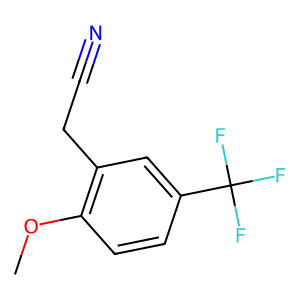
2-Methoxy-5-(trifluoromethyl)phenylacetonitrile
CAS No.:
1000542-90-4
M. Wt:
215.17
M. Fa:
C10H8F3NO
InChI Key:
XGILINGTRFYWBV-UHFFFAOYSA-N
Names and Identifiers of 1000542-90-4
CAS Number |
1000542-90-4 |
|---|---|
MDL Number |
MFCD09832243 |
IUPAC Name |
2-[2-methoxy-5-(trifluoromethyl)phenyl]acetonitrile |
InChI |
InChI=1S/C10H8F3NO/c1-15-9-3-2-8(10(11,12)13)6-7(9)4-5-14/h2-3,6H,4H2,1H3 |
InChIKey |
XGILINGTRFYWBV-UHFFFAOYSA-N |
Canonical SMILES |
COC1=C(C=C(C=C1)C(F)(F)F)CC#N |
UNSPSC Code |
12352100 |
Physical and chemical properties of 1000542-90-4
Molecular Formula |
C10H8F3NO |
|---|---|
Molecular Weight |
215.17 |
Safety Information of 1000542-90-4

Applications of 1000542-90-4
2-Methoxy-5-(trifluoromethyl)phenylacetonitrile has several applications:
- Pharmaceuticals: Its unique structure makes it a candidate for drug development, particularly in creating compounds that target specific enzymes.
- Agrochemicals: The compound may be utilized in developing herbicides or pesticides due to its biological activity.
- Material Science: Its properties may lend themselves to applications in polymer chemistry or as intermediates in synthetic pathways.
Interaction Studies of 1000542-90-4
Interaction studies have indicated that 2-Methoxy-5-(trifluoromethyl)phenylacetonitrile can bind to various biological macromolecules, affecting their function. While specific data on protein-ligand interactions are sparse, the compound's lipophilicity suggests it may interact favorably with membrane-bound proteins and enzymes. Further research is needed to elucidate these interactions and their implications for biological activity.