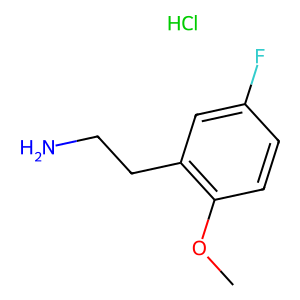
2-(5-Fluoro-2-methoxyphenyl)ethanamine hydrochloride
Names and Identifiers of 1000533-03-8
CAS Number |
1000533-03-8 |
|---|---|
EC Number |
891-701-8 |
IUPAC Name |
2-(5-fluoro-2-methoxyphenyl)ethanamine;hydrochloride |
InChI |
InChI=1S/C9H12FNO.ClH/c1-12-9-3-2-8(10)6-7(9)4-5-11;/h2-3,6H,4-5,11H2,1H3;1H |
InChIKey |
NTKBSWOIJWNLLO-UHFFFAOYSA-N |
Canonical SMILES |
COC1=C(C=C(C=C1)F)CCN.Cl |
Physical and chemical properties of 1000533-03-8
Exact Mass |
205.06700 |
|---|---|
LogP |
2.83780 |
Molecular Formula |
C9H13ClFNO |
Molecular Weight |
205.65700 |
PSA |
35.25000 |
Safety Information of 1000533-03-8

Applications of 1000533-03-8
2-(5-Fluoro-2-methoxyphenyl)ethanamine hydrochloride has several applications:
- Pharmaceutical Research: Its potential effects on neurotransmitter systems make it a candidate for drug development aimed at treating psychiatric disorders.
- Chemical Synthesis: It serves as an intermediate in the synthesis of more complex organic molecules.
- Analytical Chemistry: The compound can be used as a reference standard in analytical methods such as chromatography.
Interaction Studies of 1000533-03-8
Studies on the interactions of 2-(5-Fluoro-2-methoxyphenyl)ethanamine hydrochloride with biological systems are ongoing. Initial findings suggest that it may bind to serotonin receptors, which could elucidate its role in mood regulation and anxiety relief. Further pharmacological studies are required to fully understand its mechanism of action and potential side effects.
Biological Activity of 1000533-03-8
Research indicates that 2-(5-Fluoro-2-methoxyphenyl)ethanamine hydrochloride exhibits significant biological activity, particularly in the realm of neuropharmacology. Preliminary studies suggest that it may interact with neurotransmitter systems, potentially influencing serotonin and dopamine pathways. Due to its structural similarity to other psychoactive compounds, it is being investigated for potential therapeutic applications in treating mood disorders and other neurological conditions.