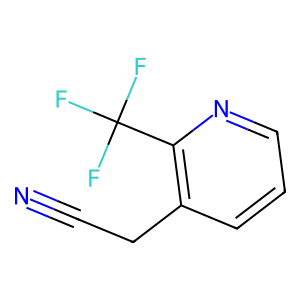
3-Pyridineacetonitrile, 2-(trifluoroMethyl)-
Names and Identifiers of 1000529-97-4
CAS Number |
1000529-97-4 |
|---|---|
IUPAC Name |
2-[2-(trifluoromethyl)pyridin-3-yl]ethanenitrile |
Canonical SMILES |
C1=CC(=C(N=C1)C(F)(F)F)CC#N |
Physical and chemical properties of 1000529-97-4
Exact Mass |
186.04000 |
|---|---|
LogP |
2.16648 |
Molecular Formula |
C8H5F3N2 |
Molecular Weight |
186.13400 |
PSA |
36.68000 |
Safety Information of 1000529-97-4

Applications of 1000529-97-4
The primary applications of 2-(Trifluoromethyl)pyridine-3-acetonitrile include:
- Agrochemicals: It serves as an intermediate for synthesizing various pesticides and herbicides that exhibit improved efficacy due to the presence of fluorine.
- Pharmaceuticals: The compound may be explored for its potential use in drug development due to its unique chemical properties that could enhance biological interactions.
- Material Science: Its distinctive electronic properties make it a candidate for developing advanced materials or coatings that require specific chemical stability and reactivity.
Interaction Studies of 1000529-97-4
Interaction studies involving 2-(Trifluoromethyl)pyridine-3-acetonitrile have focused on its reactivity with various nucleophiles and electrophiles. The presence of the trifluoromethyl group significantly influences its interaction profiles, allowing it to participate in reactions that are less favorable for non-fluorinated analogs. This characteristic is particularly valuable in medicinal chemistry where enhanced interactions can lead to improved therapeutic profiles.
Biological Activity of 1000529-97-4
Research indicates that compounds containing trifluoromethyl groups often exhibit enhanced biological activity compared to their non-fluorinated counterparts. Specifically, 2-(Trifluoromethyl)pyridine-3-acetonitrile has shown potential in agrochemical applications as an intermediate for developing pesticides and herbicides due to its ability to interact effectively with biological targets. The unique properties imparted by the trifluoromethyl group may enhance the bioavailability and efficacy of these compounds.