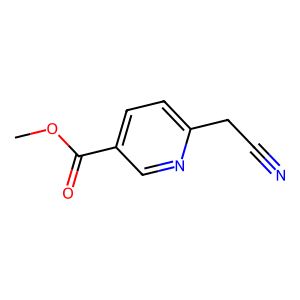
3-Pyridinecarboxylic acid, 6-(cyanoMethyl)-, Methyl ester
Names and Identifiers of 1000529-39-4
CAS Number |
1000529-39-4 |
|---|---|
MDL Number |
MFCD09924214 |
IUPAC Name |
methyl 6-(cyanomethyl)pyridine-3-carboxylate |
InChI |
InChI=1S/C9H8N2O2/c1-13-9(12)7-2-3-8(4-5-10)11-6-7/h2-3,6H,4H2,1H3 |
InChIKey |
HKDMGDHRGHVZOP-UHFFFAOYSA-N |
Canonical SMILES |
COC(=O)C1=CC=C(CC#N)N=C1 |
UNSPSC Code |
12352100 |
Physical and chemical properties of 1000529-39-4
Boiling Point |
311.0±32.0 °C at 760 mmHg |
|---|---|
Density |
1.2±0.1 g/cm3 |
Exact Mass |
176.058578 |
Flash Point |
141.9±25.1 °C |
H Bond Acceptors |
3 |
H Bond Donors |
0 |
Index of Refraction |
1.533 |
LogP |
0.11 |
Molecular Formula |
C9H8N2O2 |
Molecular Weight |
176.172 |
Vapour Pressure |
0.0±0.7 mmHg at 25°C |
Safety Information of 1000529-39-4

Applications of 1000529-39-4
Methyl 6-(cyanomethyl)nicotinate has several applications across different fields:
- Medicinal Chemistry: It is explored for its potential therapeutic effects, particularly in developing anti-inflammatory and analgesic drugs.
- Organic Synthesis: The compound serves as a versatile building block for synthesizing more complex organic molecules.
- Agricultural Chemistry: Its properties may be utilized in developing agrochemicals with specific biological activities.
The diverse applications of this compound underscore its significance in both research and industry.
Interaction Studies of 1000529-39-4
Studies focusing on the interactions of methyl 6-(cyanomethyl)nicotinate with biological systems are crucial for understanding its pharmacodynamics. Research typically investigates how this compound interacts with specific receptors or enzymes, potentially leading to therapeutic effects. Such investigations are essential for elucidating the mechanisms underlying its biological activity and optimizing its use in medicinal formulations.
Biological Activity of 1000529-39-4
Research indicates that methyl 6-(cyanomethyl)nicotinate exhibits notable biological activity. Compounds in this class have been studied for their potential pharmacological effects, including anti-inflammatory, analgesic, and antimicrobial properties. The presence of the cyanomethyl group enhances its interactions with biological targets, potentially increasing efficacy in therapeutic applications. Studies suggest that derivatives of nicotinic acid can modulate nicotinic receptors, influencing various physiological processes.