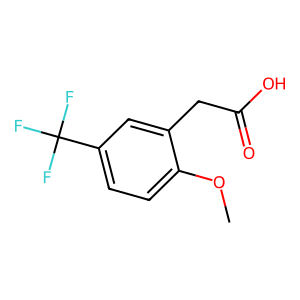
2-METHOXY-5-(TRIFLUOROMETHYL)PHENYLACETIC ACID
Names and Identifiers of 1000523-82-9
CAS Number |
1000523-82-9 |
|---|---|
MDL Number |
MFCD09832244 |
IUPAC Name |
2-[2-methoxy-5-(trifluoromethyl)phenyl]acetic acid |
InChI |
InChI=1S/C10H9F3O3/c1-16-8-3-2-7(10(11,12)13)4-6(8)5-9(14)15/h2-4H,5H2,1H3,(H,14,15) |
InChIKey |
XWXOIMXTBVKFDL-UHFFFAOYSA-N |
Canonical SMILES |
COC1=CC=C(C(F)(F)F)C=C1CC(=O)O |
UNSPSC Code |
12352100 |
Physical and chemical properties of 1000523-82-9
Molecular Formula |
C10H9F3O3 |
|---|---|
Molecular Weight |
234.17 |
Storage condition |
Store at room temperature |
Safety Information of 1000523-82-9

Interaction Studies of 1000523-82-9
The interaction studies of 2-Methoxy-5-(trifluoromethyl)phenylacetic acid reveal its role in biochemical pathways. It interacts with cytochrome P450 enzymes, which are crucial for metabolizing xenobiotics and endogenous compounds. These interactions can lead to significant cellular effects, including alterations in proliferation, differentiation, and apoptosis through modulation of specific signaling pathways.
Biological Activity of 1000523-82-9
Research indicates that 2-Methoxy-5-(trifluoromethyl)phenylacetic acid exhibits notable biological activities. It acts as a derivatizing agent in Mosher ester and amide analyses, interacting with secondary alcohols and amines to form esters or amides. This interaction suggests potential applications in biochemical pathways related to the metabolism of these biomolecules. Additionally, its structural features allow it to influence various cellular processes, including modulation of cell signaling pathways and gene expression, which may lead to therapeutic effects.