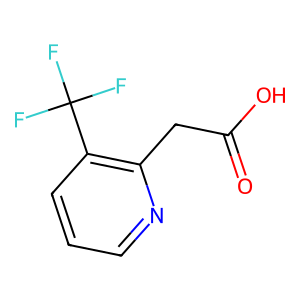
2-(3-(Trifluoromethyl)pyridin-2-yl)acetic acid
CAS No.:
1000521-27-6
M. Wt:
205.13400
M. Fa:
C8H6F3NO2
InChI Key:
CGXGLHGMLGPAQT-UHFFFAOYSA-N
Appearance:
White Solid
Names and Identifiers of 1000521-27-6
CAS Number |
1000521-27-6 |
|---|---|
MDL Number |
MFCD09924925 |
IUPAC Name |
2-[3-(trifluoromethyl)pyridin-2-yl]acetic acid |
InChI |
InChI=1S/C8H6F3NO2/c9-8(10,11)5-2-1-3-12-6(5)4-7(13)14/h1-3H,4H2,(H,13,14) |
InChIKey |
CGXGLHGMLGPAQT-UHFFFAOYSA-N |
Canonical SMILES |
C1=CC(=C(N=C1)CC(=O)O)C(F)(F)F |
UNSPSC Code |
12352100 |
Physical and chemical properties of 1000521-27-6
Exact Mass |
205.03500 |
|---|---|
LogP |
1.72750 |
Molecular Formula |
C8H6F3NO2 |
Molecular Weight |
205.13400 |
PSA |
50.19000 |
Storage condition |
Inert atmosphere,Store in freezer, under -20°C |
Safety Information of 1000521-27-6

Applications of 1000521-27-6
This compound has several applications, including:
- Reagent in Organic Synthesis: It is used as a building block in the synthesis of more complex organic molecules.
- Additive in Coatings: Due to its chemical stability and properties, it is utilized as an additive in protective bonding agents and coatings formulations.
- Potential Pharmaceutical Intermediates: Its unique structure may serve as a precursor for developing new pharmaceutical agents.
Interaction Studies of 1000521-27-6
While specific interaction studies involving 2-(3-(Trifluoromethyl)pyridin-2-yl)acetic acid are scarce, its structural characteristics suggest that it could interact with various biological macromolecules. The trifluoromethyl group may enhance binding affinity to certain targets, making it a candidate for further pharmacological studies.