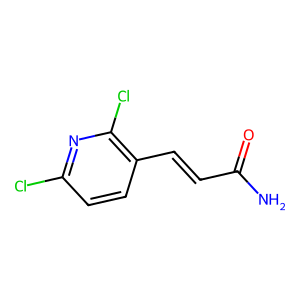
(2E)-3-(2,6-DIchloropyridin-3-yl)prop-2-enamide
Names and Identifiers of 1000519-96-9
CAS Number |
1000519-96-9 |
|---|---|
IUPAC Name |
(E)-3-(2,6-dichloropyridin-3-yl)prop-2-enamide |
InChI |
InChI=1S/C8H6Cl2N2O/c9-6-3-1-5(8(10)12-6)2-4-7(11)13/h1-4H,(H2,11,13)/b4-2+ |
InChIKey |
IUANTXONUKBMJJ-DUXPYHPUSA-N |
Canonical SMILES |
C1=CC(=NC(=C1C=CC(=O)N)Cl)Cl |
Isomeric SMILES |
C1=CC(=NC(=C1/C=C/C(=O)N)Cl)Cl |
Physical and chemical properties of 1000519-96-9
Molecular Formula |
C8H6Cl2N2O |
|---|---|
Molecular Weight |
217.05 |
Applications of 1000519-96-9
(2E)-3-(2,6-Dichloropyridin-3-yl)prop-2-enamide has potential applications in:
- Medicinal Chemistry: As a lead compound for developing anti-inflammatory or anti-cancer agents.
- Agrochemicals: It may serve as an active ingredient in pesticides or herbicides due to its biological activity against pests.
- Organic Synthesis: This compound can be utilized as a building block in the synthesis of more complex organic molecules.
Interaction Studies of 1000519-96-9
Interaction studies have shown that (2E)-3-(2,6-Dichloropyridin-3-yl)prop-2-enamide may bind to specific targets within biological systems. These interactions can modulate enzyme activities or receptor functions, leading to therapeutic effects. For instance, preliminary studies suggest that this compound could inhibit cyclooxygenase enzymes, thereby reducing inflammation. Further research is needed to elucidate its precise mechanisms of action and target specificity.
Biological Activity of 1000519-96-9
The biological activity of (2E)-3-(2,6-Dichloropyridin-3-yl)prop-2-enamide has been explored in various studies. It exhibits potential anti-inflammatory and anti-cancer properties. The dichloropyridine moiety may enhance its interaction with specific biological targets, such as enzymes or receptors involved in inflammatory pathways. Research indicates that compounds with similar structures often show activity against cyclooxygenase enzymes, which are crucial in the inflammatory response.