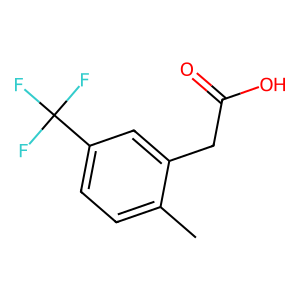
2-METHYL-5-(TRIFLUOROMETHYL)PHENYLACETIC ACID
Names and Identifiers of 1000517-01-0
CAS Number |
1000517-01-0 |
|---|---|
MDL Number |
MFCD09832286 |
IUPAC Name |
2-[2-methyl-5-(trifluoromethyl)phenyl]acetic acid |
InChI |
InChI=1S/C10H9F3O2/c1-6-2-3-8(10(11,12)13)4-7(6)5-9(14)15/h2-4H,5H2,1H3,(H,14,15) |
InChIKey |
JUHQANJHRWBIKL-UHFFFAOYSA-N |
Canonical SMILES |
CC1=CC=C(C(F)(F)F)C=C1CC(=O)O |
UNSPSC Code |
12352100 |
Physical and chemical properties of 1000517-01-0
Boiling Point |
273.1±35.0 °C at 760 mmHg |
|---|---|
Density |
1.3±0.1 g/cm3 |
Exact Mass |
218.055466 |
Flash Point |
119.0±25.9 °C |
Index of Refraction |
1.478 |
LogP |
2.54 |
Molecular Formula |
C10H9F3O2 |
Molecular Weight |
218.173 |
Vapour Pressure |
0.0±0.6 mmHg at 25°C |
Safety Information of 1000517-01-0

Applications of 1000517-01-0
2-Methyl-5-(trifluoromethyl)phenylacetic acid has several applications across various fields:
- Pharmaceuticals: It serves as an intermediate in the synthesis of bioactive compounds and drugs due to its pharmacological properties.
- Agricultural Chemicals: Its unique properties make it suitable for developing agrochemicals that require specific biological activity.
- Research: Used as a reagent in organic synthesis and medicinal chemistry for exploring structure-activity relationships.
Interaction Studies of 1000517-01-0
Interaction studies involving 2-Methyl-5-(trifluoromethyl)phenylacetic acid focus on its binding affinity to various biological targets. Preliminary studies suggest that it may interact with enzymes involved in inflammatory pathways, which could explain its observed biological effects. Further research is necessary to elucidate these interactions at the molecular level.
Biological Activity of 1000517-01-0
Research indicates that 2-Methyl-5-(trifluoromethyl)phenylacetic acid exhibits significant biological activity, particularly in pharmacological contexts. Its structural features allow it to interact with biological targets effectively, making it a candidate for drug development. Studies have shown potential anti-inflammatory and analgesic properties, although specific mechanisms of action are still under investigation.