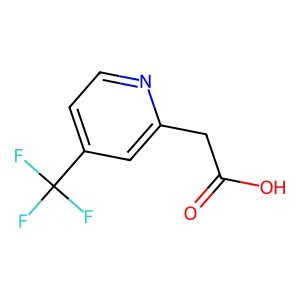
(4-Trifluoromethyl-pyridin-2-yl)-acetic acid
CAS No.:
1000515-78-5
M. Wt:
205.134
M. Fa:
C8H6F3NO2
InChI Key:
BVLVCJRDGKYAOK-UHFFFAOYSA-N
Names and Identifiers of 1000515-78-5
CAS Number |
1000515-78-5 |
|---|---|
MDL Number |
MFCD09924926 |
IUPAC Name |
2-[4-(trifluoromethyl)pyridin-2-yl]acetic acid |
InChI |
InChI=1S/C8H6F3NO2/c9-8(10,11)5-1-2-12-6(3-5)4-7(13)14/h1-3H,4H2,(H,13,14) |
InChIKey |
BVLVCJRDGKYAOK-UHFFFAOYSA-N |
Canonical SMILES |
O=C(O)CC1=CC(C(F)(F)F)=CC=N1 |
UNSPSC Code |
12352100 |
Physical and chemical properties of 1000515-78-5
Boiling Point |
276.7±35.0 °C at 760 mmHg |
|---|---|
Density |
1.4±0.1 g/cm3 |
Exact Mass |
205.035065 |
Flash Point |
121.1±25.9 °C |
Index of Refraction |
1.475 |
LogP |
0.58 |
Molecular Formula |
C8H6F3NO2 |
Molecular Weight |
205.134 |
PSA |
50.19000 |
Vapour Pressure |
0.0±0.6 mmHg at 25°C |
Safety Information of 1000515-78-5

Applications of 1000515-78-5
2-(4-(Trifluoromethyl)pyridin-2-yl)acetic acid has several applications across different sectors:
- Pharmaceuticals: It serves as an intermediate in the synthesis of various drugs due to its biological activity.
- Agricultural Chemicals: Its properties make it a candidate for developing herbicides or fungicides.
- Chemical Research: Used as a building block in organic synthesis for creating more complex molecules.
Interaction Studies of 1000515-78-5
Interaction studies involving 2-(4-(Trifluoromethyl)pyridin-2-yl)acetic acid focus on its binding affinity with biological targets. Research has shown that:
- It may interact with specific enzymes or receptors, influencing biochemical pathways.
- Studies on its antagonistic or agonistic effects on certain biological targets are ongoing to evaluate its therapeutic potential.
Several compounds share structural similarities with 2-(4-(Trifluoromethyl)pyridin-2-yl)acetic acid, including:
- 2-(4-Trifluoromethyl)pyridinecarboxylic acid: Similar in structure but differs in the position of the carboxylic group.
- 4-Trifluoromethylpyridine: Lacks the acetic acid component but retains the trifluoromethyl group.
- Pyridine derivatives with halogen substitutions: These compounds often exhibit similar reactivity and biological activity.
| Compound Name | Structure Features | Unique Properties |
|---|---|---|
| 2-(4-(Trifluoromethyl)pyridin-2-yl)acetic acid | Trifluoromethyl and acetic acid | Significant biological activity |
| 2-(4-Trifluoromethyl)pyridinecarboxylic acid | Trifluoromethyl and carboxylic acid | Different carboxylic position |
| 4-Trifluoromethylpyridine | Trifluoromethyl only | Lacks acetic functionality |
| Pyridine derivatives with halogen substitutions | Varies based on halogen position | Diverse reactivity profiles |
Biological Activity of 1000515-78-5
Research indicates that 2-(4-(Trifluoromethyl)pyridin-2-yl)acetic acid exhibits significant biological activity. Compounds with similar structures have been studied for their potential as:
- Antimicrobial Agents: Some derivatives show activity against bacterial strains.
- Anti-inflammatory Agents: The compound may modulate inflammatory pathways, offering therapeutic potential.
- Cytotoxicity: Certain studies suggest that it may have cytotoxic effects on cancer cell lines, making it a candidate for further investigation in cancer therapy.