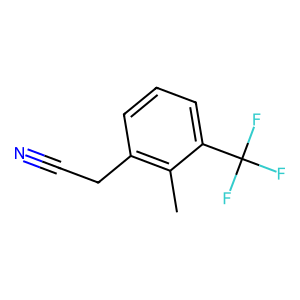
2-Methyl-3-(trifluoromethyl)phenylacetonitrile
CAS No.:
1000515-00-3
M. Wt:
199.172
M. Fa:
C10H8F3N
InChI Key:
VSBABDIMZJXXIU-UHFFFAOYSA-N
Names and Identifiers of 1000515-00-3
CAS Number |
1000515-00-3 |
|---|---|
MDL Number |
MFCD09832278 |
IUPAC Name |
2-[2-methyl-3-(trifluoromethyl)phenyl]acetonitrile |
InChI |
InChI=1S/C10H8F3N/c1-7-8(5-6-14)3-2-4-9(7)10(11,12)13/h2-4H,5H2,1H3 |
InChIKey |
VSBABDIMZJXXIU-UHFFFAOYSA-N |
Canonical SMILES |
CC1=C(C=CC=C1C(F)(F)F)CC#N |
UNSPSC Code |
12352100 |
Physical and chemical properties of 1000515-00-3
Boiling Point |
234.5±35.0 °C at 760 mmHg |
|---|---|
Density |
1.2±0.1 g/cm3 |
Exact Mass |
199.060883 |
Flash Point |
95.6±25.9 °C |
Index of Refraction |
1.463 |
LogP |
2.48 |
Melting Point |
51-55℃ |
Molecular Formula |
C10H8F3N |
Molecular Weight |
199.172 |
Vapour Pressure |
0.1±0.5 mmHg at 25°C |
Safety Information of 1000515-00-3

Applications of 1000515-00-3
2-Methyl-3-(trifluoromethyl)phenylacetonitrile finds applications in various fields:
- Pharmaceuticals: It serves as an intermediate in the synthesis of pharmaceuticals due to its unique functional groups.
- Agricultural Chemicals: The compound may be utilized in developing agrochemicals, particularly those targeting pest control.
- Material Science: Its properties make it suitable for use in developing advanced materials with specific thermal and chemical resistance.
Interaction Studies of 1000515-00-3
Interaction studies involving 2-Methyl-3-(trifluoromethyl)phenylacetonitrile focus on its reactivity with biological molecules and other chemicals. Investigations into its binding affinity with enzymes or receptors are crucial for understanding its potential therapeutic applications. Additionally, studies on its interaction with various solvents and reagents help elucidate its behavior in different chemical environments.