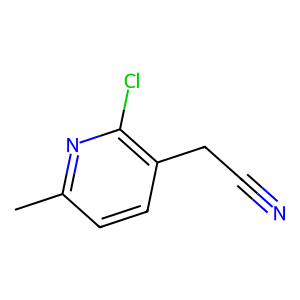
2-(2-Chloro-6-methylpyridin-3-yl)acetonitrile
Names and Identifiers of 1000514-91-9
CAS Number |
1000514-91-9 |
|---|---|
IUPAC Name |
2-(2-chloro-6-methylpyridin-3-yl)acetonitrile |
InChI |
InChI=1S/C8H7ClN2/c1-6-2-3-7(4-5-10)8(9)11-6/h2-3H,4H2,1H3 |
InChIKey |
QRYFRROYXPUUEZ-UHFFFAOYSA-N |
Canonical SMILES |
CC1=NC(=C(C=C1)CC#N)Cl |
Physical and chemical properties of 1000514-91-9
Acidity coefficient |
0.54±0.10(Predicted) |
|---|---|
Boiling Point |
297.8±35.0 °C(Predicted) |
Density |
1?+-.0.06 g/cm3(Predicted) |
Molecular Formula |
C8H7ClN2 |
Molecular Weight |
166.61 |
Safety Information of 1000514-91-9

Applications of 1000514-91-9
This compound finds applications in various fields:
- Pharmaceuticals: As a building block for synthesizing drugs targeting neurological disorders and inflammation.
- Organic Synthesis: Employed as an intermediate in the synthesis of more complex organic compounds.
- Material Science: Potential use in developing new materials due to its unique electronic properties.
Interaction Studies of 1000514-91-9
Studies have shown that 2-(2-Chloro-6-methylpyridin-3-yl)acetonitrile interacts with several biological targets, particularly within the central nervous system. Its structural features allow it to modulate receptor activity, which is crucial for developing therapeutic agents aimed at cognitive impairments and other neurological conditions.
Biological Activity of 1000514-91-9
Research indicates that compounds similar to 2-(2-Chloro-6-methylpyridin-3-yl)acetonitrile exhibit significant biological activities, including potential anti-inflammatory and anticancer properties. The presence of the pyridine moiety is often associated with interactions at various biological targets, such as receptors involved in neurotransmission and inflammation.