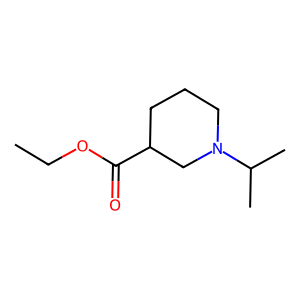
ethyl 1-isopropylpiperidine-3-carboxylate
Names and Identifiers of 100050-03-1
CAS Number |
100050-03-1 |
|---|---|
MDL Number |
MFCD13248694 |
IUPAC Name |
ethyl 1-propan-2-ylpiperidine-3-carboxylate |
InChI |
InChI=1S/C11H21NO2/c1-4-14-11(13)10-6-5-7-12(8-10)9(2)3/h9-10H,4-8H2,1-3H3 |
InChIKey |
ILEWGMFFMZYVCG-UHFFFAOYSA-N |
Canonical SMILES |
CCOC(=O)C1CCCN(C(C)C)C1 |
UNSPSC Code |
12352100 |
Physical and chemical properties of 100050-03-1
Acidity coefficient |
9.40±0.50(Predicted) |
|---|---|
Boiling Point |
245.2±33.0 °C(Predicted) |
Density |
0.978±0.06 g/cm3(Predicted) |
Exact Mass |
199.15700 |
LogP |
1.60780 |
Molecular Formula |
C11H21NO2 |
Molecular Weight |
199.29000 |
PSA |
29.54000 |
Safety Information of 100050-03-1

Applications of 100050-03-1
Ethyl 1-isopropylpiperidine-3-carboxylate finds applications primarily in:
- Medicinal Chemistry: As a scaffold for developing new therapeutic agents.
- Proteomics Research: Utilized in the study of protein interactions and functions due to its unique chemical properties.
- Synthetic Chemistry: Serving as an intermediate in the synthesis of more complex molecules.
Interaction Studies of 100050-03-1
Studies on ethyl 1-isopropylpiperidine-3-carboxylate's interactions with biological targets have shown promising results. Its derivatives have been evaluated for their binding affinities to various receptors, indicating potential use in treating conditions related to neurotransmitter systems. The interaction studies highlight its relevance in drug design and development.
Biological Activity of 100050-03-1
Research indicates that compounds related to ethyl 1-isopropylpiperidine-3-carboxylate exhibit various biological activities. Notably, piperidine derivatives have been studied for their potential as analgesics and anti-inflammatory agents. The structural modifications provided by the isopropyl and ethyl groups may enhance these biological properties, making them valuable in drug development.
 Cas:5006-62-2

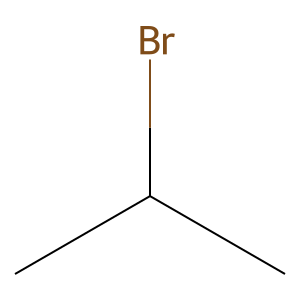 Cas:75-26-3
