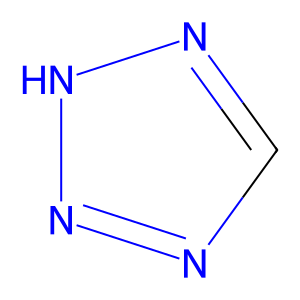
1H-Tetrazole
CAS No.:
100043-29-6
M. Wt:
70.05340
M. Fa:
CH2N4
InChI Key:
KJUGUADJHNHALS-UHFFFAOYSA-N
Names and Identifiers of 100043-29-6
CAS Number |
100043-29-6 |
|---|---|
EC Number |
206-023-4 |
IUPAC Name |
2H-tetrazole |
InChI |
InChI=1S/CH2N4/c1-2-4-5-3-1/h1H,(H,2,3,4,5) |
InChIKey |
KJUGUADJHNHALS-UHFFFAOYSA-N |
Canonical SMILES |
C1=NNN=N1 |
UNII |
D34J7PAT68 |
Physical and chemical properties of 100043-29-6
Exact Mass |
70.02790 |
|---|---|
Molecular Formula |
CH2N4 |
Molecular Weight |
70.05340 |
PSA |
54.46000 |
Safety Information of 100043-29-6


Applications of 100043-29-6
1H-Tetrazole has several important applications:
- Pharmaceuticals: It serves as a scaffold in drug design due to its biological activity and ability to form stable complexes with metal ions.
- Explosives: Due to its energetic properties, certain tetrazole derivatives are utilized in the formulation of explosives.
- Biochemistry: Dilute solutions of 1H-tetrazole are used in DNA synthesis and other biochemical applications due to its solubility and reactivity.
Interaction Studies of 100043-29-6
Studies have explored the interactions of 1H-tetrazole with various biological targets. These include:
- Metal Ion Complexation: Research indicates that 1H-tetrazole can form stable complexes with transition metals, which can enhance biological activity or alter pharmacokinetics.
- Receptor Binding Studies: Some tetrazole derivatives have been evaluated for their ability to bind to specific receptors, influencing their therapeutic potential.
Biological Activity of 100043-29-6
1H-Tetrazole exhibits a range of biological activities, making it a compound of interest in medicinal chemistry. Its derivatives have been studied for:
- Antimicrobial Properties: Certain 1H-tetrazole derivatives show activity against various bacterial strains.
- Anticancer Activity: Some studies suggest that 1H-tetrazole derivatives may inhibit cancer cell proliferation through various mechanisms.
- Anti-inflammatory Effects: Research indicates potential anti-inflammatory properties linked to specific tetrazole compounds.