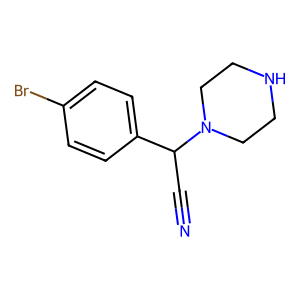
2-(4-Bromophenyl)-2-(piperazin-1-yl)acetonitrile
Names and Identifiers of 1000406-20-1
CAS Number |
1000406-20-1 |
|---|---|
IUPAC Name |
2-(4-bromophenyl)-2-piperazin-1-ylacetonitrile |
InChI |
InChI=1S/C12H14BrN3/c13-11-3-1-10(2-4-11)12(9-14)16-7-5-15-6-8-16/h1-4,12,15H,5-8H2 |
InChIKey |
XVWJNCXBTLEMBD-UHFFFAOYSA-N |
Canonical SMILES |
C1CN(CCN1)C(C#N)C2=CC=C(C=C2)Br |
Physical and chemical properties of 1000406-20-1
Acidity coefficient |
8.67±0.10(Predicted) |
|---|---|
Boiling Point |
384.8±42.0 °C(Predicted) |
Density |
1.410±0.06 g/cm3(Predicted) |
Safety Information of 1000406-20-1

Applications of 1000406-20-1
Interaction Studies of 1000406-20-1
Research into the interaction of 2-(4-Bromophenyl)-2-(piperazin-1-yl)acetonitrile with biological targets has revealed its potential to influence receptor activity and enzyme function. Studies suggest that compounds with similar piperazine structures often engage in significant interactions with neurotransmitter receptors, which may lead to therapeutic effects. Further investigation into its binding affinity and mechanism of action could elucidate its role in pharmacology.
Biological Activity of 1000406-20-1
The biological activity of 2-(4-Bromophenyl)-2-(piperazin-1-yl)acetonitrile is linked to its interaction with specific receptors and enzymes within biological systems. It has been shown to modulate neurotransmitter pathways, which may contribute to its pharmacological effects. Studies indicate that compounds with similar structures often exhibit significant activity against various biological targets, making this compound a candidate for further exploration in drug development.