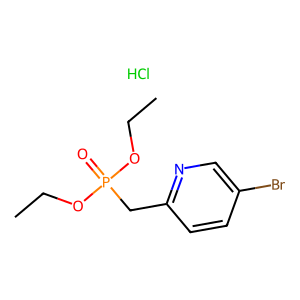
5-bromo-2-(diethoxyphosphorylmethyl)pyridine;hydrochloride
Names and Identifiers of 1000400-92-9
CAS Number |
1000400-92-9 |
|---|---|
IUPAC Name |
5-bromanyl-2-(diethoxyphosphorylmethyl)pyridine;hydrochloride |
Canonical SMILES |
CCOP(=O)(CC1=NC=C(C=C1)Br)OCC.Cl |
Physical and chemical properties of 1000400-92-9
Molecular Formula |
C10H16BrClNO3P |
|---|---|
Molecular Weight |
344.57 |
Safety Information of 1000400-92-9

Applications of 1000400-92-9
Diethyl [(5-bromopyridin-2-yl)methyl]phosphonate hydrochloride has several applications across different fields:
- Pharmaceutical Research: As a potential lead compound in drug discovery, particularly in developing new anticancer or antimicrobial agents.
- Agricultural Chemistry: It may be used as a pesticide or herbicide due to its biological activity against pests.
- Chemical Synthesis: This compound serves as an intermediate in synthesizing more complex organic molecules.
Its versatility makes it valuable in both research and industrial contexts.
Interaction Studies of 1000400-92-9
Interaction studies involving Diethyl [(5-bromopyridin-2-yl)methyl]phosphonate hydrochloride focus on its binding affinity with various biological targets. These studies include:
- Protein Binding Studies: Investigating how well the compound binds to proteins associated with disease pathways.
- Enzyme Inhibition Assays: Evaluating its effectiveness as an inhibitor against specific enzymes involved in metabolic processes.
- Cellular Uptake Studies: Understanding how effectively the compound penetrates cell membranes and its subsequent biological effects.
These interactions are critical for assessing the compound's therapeutic potential and safety profile.
Biological Activity of 1000400-92-9
The biological activity of Diethyl [(5-bromopyridin-2-yl)methyl]phosphonate hydrochloride is largely attributed to its structural features. Compounds with similar structures have been investigated for their potential as:
- Anticancer Agents: Some studies suggest that phosphonates can inhibit tumor growth through various mechanisms.
- Antimicrobial Activity: The presence of the brominated pyridine moiety may enhance the compound's ability to combat bacterial infections.
- Enzyme Inhibitors: Phosphonates are known to act as inhibitors for specific enzymes, particularly in metabolic pathways.
Research into this specific compound's biological effects is ongoing, with preliminary studies indicating promising results in these areas.