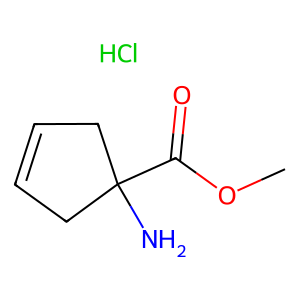
1-Amino-cyclopent-3-enecarboxylic acid methyl ester hydrochloride
CAS No.:
1000386-67-3
M. Wt:
177.62900
M. Fa:
C7H12ClNO2
InChI Key:
DPJYGUSVJCORRG-UHFFFAOYSA-N
Names and Identifiers of 1000386-67-3
CAS Number |
1000386-67-3 |
|---|---|
EC Number |
871-896-6 |
IUPAC Name |
methyl 1-aminocyclopent-3-ene-1-carboxylate;hydrochloride |
InChI |
InChI=1S/C7H11NO2.ClH/c1-10-6(9)7(8)4-2-3-5-7;/h2-3H,4-5,8H2,1H3;1H |
InChIKey |
DPJYGUSVJCORRG-UHFFFAOYSA-N |
Canonical SMILES |
COC(=O)C1(CC=CC1)N.Cl |
Physical and chemical properties of 1000386-67-3
Exact Mass |
177.05600 |
|---|---|
LogP |
1.70920 |
Molecular Formula |
C7H12ClNO2 |
Molecular Weight |
177.62900 |
PSA |
52.32000 |
Safety Information of 1000386-67-3

Applications of 1000386-67-3
Methyl 1-aminocyclopent-3-ene-1-carboxylate hydrochloride has potential applications in:
- Pharmaceutical Development: As a building block for synthesizing novel drugs targeting neurological disorders.
- Research: In studies investigating cyclopentene derivatives and their biological effects.
- Chemical Synthesis: As an intermediate in organic synthesis due to its reactive functional groups.
These applications underscore its relevance in both academic research and industrial settings.
Interaction Studies of 1000386-67-3
Interaction studies involving methyl 1-aminocyclopent-3-ene-1-carboxylate hydrochloride focus on its binding affinity to various biological targets. Preliminary data suggest that compounds with similar structures may interact with receptors involved in neurotransmission and other physiological processes. Understanding these interactions is crucial for elucidating the compound's potential therapeutic effects and safety profile.