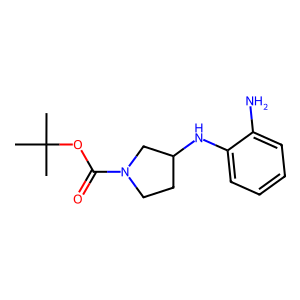
(R)-tert-Butyl 3-((2-aminophenyl)amino)pyrrolidine-1-carboxylate
Names and Identifiers of 1000370-80-8
CAS Number |
1000370-80-8 |
|---|---|
IUPAC Name |
tert-butyl (3R)-3-(2-aminoanilino)pyrrolidine-1-carboxylate |
InChI |
InChI=1S/C15H23N3O2/c1-15(2,3)20-14(19)18-9-8-11(10-18)17-13-7-5-4-6-12(13)16/h4-7,11,17H,8-10,16H2,1-3H3/t11-/m1/s1 |
InChIKey |
UPRQOXULXDFABD-LLVKDONJSA-N |
Canonical SMILES |
CC(C)(C)OC(=O)N1CCC(C1)NC2=CC=CC=C2N |
Isomeric SMILES |
CC(C)(C)OC(=O)N1CC[C@H](C1)NC2=CC=CC=C2N |
Physical and chemical properties of 1000370-80-8
Boiling Point |
428.7±40.0 °C at 760 mmHg |
|---|---|
Density |
1.2±0.1 g/cm3 |
Exact Mass |
277.179016 |
Flash Point |
213.0±27.3 °C |
Index of Refraction |
1.602 |
LogP |
1.30 |
Molecular Formula |
C15H23N3O2 |
Molecular Weight |
277.362 |
Vapour Pressure |
0.0±1.0 mmHg at 25°C |
Applications of 1000370-80-8
(R)-tert-Butyl 3-((2-aminophenyl)amino)pyrrolidine-1-carboxylate has potential applications in:
- Pharmaceutical Development: As a lead compound for designing drugs targeting beta-3 adrenergic receptors.
- Biological Research: To study metabolic pathways and receptor interactions.
- Chemical Biology: As a probe to investigate the role of amino-substituted pyrrolidines in biological systems.
Interaction Studies of 1000370-80-8
Interaction studies involving (R)-tert-Butyl 3-((2-aminophenyl)amino)pyrrolidine-1-carboxylate focus on its binding affinity and efficacy at beta-3 adrenergic receptors. These studies utilize techniques such as radiolabeled ligand binding assays and functional assays to assess the compound's pharmacological profile. Preliminary results indicate that this compound may exhibit selective activity towards specific receptor subtypes, which is critical for minimizing side effects in therapeutic applications.
Biological Activity of 1000370-80-8
Research indicates that (R)-tert-Butyl 3-((2-aminophenyl)amino)pyrrolidine-1-carboxylate exhibits significant biological activity, particularly as a potential beta-3 adrenergic receptor agonist. This receptor is involved in various physiological processes, including energy metabolism and thermogenesis. Studies have shown that compounds with similar structures can modulate these receptors, suggesting that this compound may have therapeutic implications in obesity management and metabolic disorders.