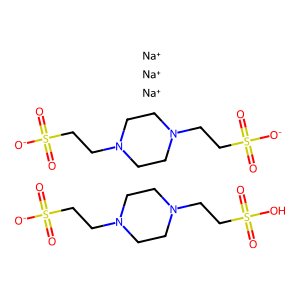
1,4-Piperazinediethanesulfonic acid, sodium salt (2:3)
Names and Identifiers of 100037-69-2
CAS Number |
100037-69-2 |
|---|---|
EC Number |
600-018-4 |
IUPAC Name |
trisodium;2-[4-(2-sulfoethyl)piperazin-1-yl]ethanesulfonate;2-[4-(2-sulfonatoethyl)piperazin-1-yl]ethanesulfonate |
InChI |
InChI=1S/2C8H18N2O6S2.3Na/c2*11-17(12,13)7-5-9-1-2-10(4-3-9)6-8-18(14,15)16;;;/h2*1-8H2,(H,11,12,13)(H,14,15,16);;;/q;;3*+1/p-3 |
InChIKey |
FPDACHMSOMILQI-UHFFFAOYSA-K |
Canonical SMILES |
C1CN(CCN1CCS(=O)(=O)O)CCS(=O)(=O)[O-].C1CN(CCN1CCS(=O)(=O)[O-])CCS(=O)(=O)[O-].[Na+].[Na+].[Na+] |
Physical and chemical properties of 100037-69-2
Acidity coefficient |
6.8(at 25℃) |
|---|---|
Exact Mass |
670.067078 |
Melting Point |
300 °C |
Molecular Formula |
C8H18N2NaO6S2 |
Molecular Weight |
336.86 |
pH Range |
6.1 - 7.5 |
PSA |
272.45000 |
Solubility |
H2O: 0.5 g/mL, clear, colorless |
Storage condition |
Store at RT. |
Water Solubility |
soluble |
Applications of 100037-69-2
Trisodium 2-[4-(2-sulfoethyl)piperazin-1-yl]ethanesulfonate finds numerous applications in:
- Biochemical Research: Used as a buffering agent in various assays and experiments.
- Cell Culture: Maintains optimal pH conditions for cell growth and viability.
- Pharmaceutical Development: Acts as an excipient in drug formulations to stabilize active ingredients.
Its unique properties make it indispensable in many laboratory settings .
Interaction Studies of 100037-69-2
Studies on the interactions of trisodium 2-[4-(2-sulfoethyl)piperazin-1-yl]ethanesulfonate with biomolecules have shown that it can effectively stabilize protein structures during purification processes. Its zwitterionic nature minimizes non-specific binding, enhancing the purity of isolated proteins. Additionally, interaction studies have demonstrated its compatibility with various enzymes, maintaining their activity across a range of pH levels .
Biological Activity of 100037-69-2
The biological activity of trisodium 2-[4-(2-sulfoethyl)piperazin-1-yl]ethanesulfonate is primarily attributed to its buffering capacity. It maintains the pH stability required for enzyme activity and cellular processes. Additionally, it has been shown to have minimal toxicity, making it suitable for use in cell culture and other biological assays. Its zwitterionic nature allows it to interact effectively with biomolecules without interfering with their function .