![structure of tert-butyl 4'-oxo-3',4'-dihydro-1H,1'H-spiro[piperidine-4,2'-quinazoline]-1-carboxylate](https://molwiki.oss-cn-hongkong.aliyuncs.com/structure/55/1000356-55-7.svg)
tert-butyl 4'-oxo-3',4'-dihydro-1H,1'H-spiro[piperidine-4,2'-quinazoline]-1-carboxylate
Names and Identifiers of 1000356-55-7
CAS Number |
1000356-55-7 |
|---|---|
IUPAC Name |
tert-butyl 4-oxospiro[1,3-dihydroquinazoline-2,4'-piperidine]-1'-carboxylate |
InChI |
InChI=1S/C17H23N3O3/c1-16(2,3)23-15(22)20-10-8-17(9-11-20)18-13-7-5-4-6-12(13)14(21)19-17/h4-7,18H,8-11H2,1-3H3,(H,19,21) |
InChIKey |
FMGRFCGCYQWSLF-UHFFFAOYSA-N |
Canonical SMILES |
CC(C)(C)OC(=O)N1CCC2(CC1)NC3=CC=CC=C3C(=O)N2 |
Physical and chemical properties of 1000356-55-7
Exact Mass |
317.17400 |
|---|---|
LogP |
2.65540 |
Molecular Formula |
C17H23N3O3 |
Molecular Weight |
317.38300 |
PSA |
74.16000 |
Applications of 1000356-55-7
tert-Butyl 4'-oxo-3',4'-dihydro-1'H-spiro[piperidine-4,2'-quinazoline]-1-carboxylate has several applications across various fields:
- Medicinal Chemistry: It serves as a valuable intermediate in the development of novel pharmaceutical agents.
- Organic Synthesis: The compound acts as a versatile building block for synthesizing more complex organic molecules.
- Biological Research: Its unique properties make it useful in studies exploring biological interactions and mechanisms.
- Material Science: Potential applications in developing new materials with tailored properties are also being explored.
Interaction Studies of 1000356-55-7
Interaction studies of tert-butyl 4'-oxo-3',4'-dihydro-1'H-spiro[piperidine-4,2'-quinazoline]-1-carboxylate focus on its binding affinity to various molecular targets. These studies may involve:
- Enzyme Inhibition Assays: To evaluate its role in modulating enzymatic activities.
- Receptor Binding Studies: To determine its potential as a ligand for specific receptors involved in disease pathways.
Such investigations are critical for understanding the compound's therapeutic potential and mechanisms of action.
Biological Activity of 1000356-55-7
Research indicates that tert-butyl 4'-oxo-3',4'-dihydro-1'H-spiro[piperidine-4,2'-quinazoline]-1-carboxylate exhibits various biological activities. Preliminary studies suggest potential antimicrobial and anticancer properties, making it a candidate for further pharmacological investigation. Its unique structural features allow for interactions with specific biological targets, which may modulate enzyme activities or cellular pathways.
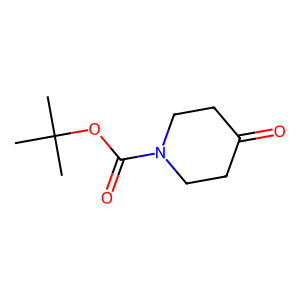 Cas:79099-07-3

 Cas:88-68-6
