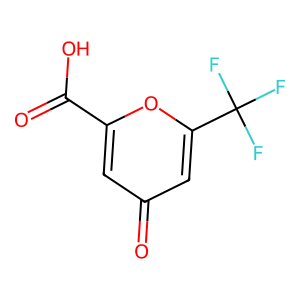
4-oxo-6-(trifluoromethyl)-4H-pyran-2-carboxylic acid
Names and Identifiers of 1000350-06-0
CAS Number |
1000350-06-0 |
|---|---|
IUPAC Name |
4-oxo-6-(trifluoromethyl)pyran-2-carboxylic acid |
InChI |
InChI=1S/C7H3F3O4/c8-7(9,10)5-2-3(11)1-4(14-5)6(12)13/h1-2H,(H,12,13) |
InChIKey |
JGVPJIFWDKSYJL-UHFFFAOYSA-N |
Canonical SMILES |
C1=C(OC(=CC1=O)C(F)(F)F)C(=O)O |
Physical and chemical properties of 1000350-06-0
Exact Mass |
207.99800 |
|---|---|
LogP |
1.35680 |
Molecular Formula |
C7H3F3O4 |
Molecular Weight |
208.09200 |
PSA |
67.51000 |
Applications of 1000350-06-0
Due to its unique structure and properties, 4-oxo-6-(trifluoromethyl)-4H-pyran-2-carboxylic acid finds applications in several areas:
- Medicinal Chemistry: As a potential lead compound for the development of new pharmaceuticals.
- Material Science: In the synthesis of functional materials due to its ability to form polymers or complex structures.
- Agricultural Chemistry: Possible use in developing agrochemicals that target specific pests or diseases.
The trifluoromethyl group enhances lipophilicity, which may improve bioavailability and efficacy in these applications.
Interaction Studies of 1000350-06-0
Interaction studies involving 4-oxo-6-(trifluoromethyl)-4H-pyran-2-carboxylic acid focus on its reactivity with various nucleophiles and electrophiles. The presence of the trifluoromethyl group significantly alters the electronic properties of the molecule, making it an interesting subject for studies aimed at understanding how such modifications affect reactivity patterns. These studies are crucial for designing derivatives with tailored properties for specific applications.
Biological Activity of 1000350-06-0
Research into the biological activity of 4-oxo-6-(trifluoromethyl)-4H-pyran-2-carboxylic acid has indicated potential pharmacological properties. Compounds containing trifluoromethyl groups are often associated with enhanced biological activity due to their electron-withdrawing effects, which can influence the interaction of these molecules with biological targets. Specific studies have suggested that derivatives of this compound may exhibit antimicrobial and anti-inflammatory properties, although comprehensive biological evaluations are still needed to fully elucidate its therapeutic potential.