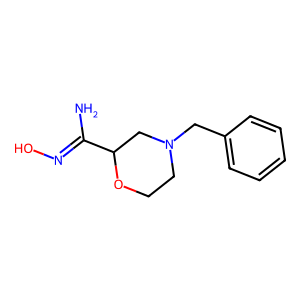
4-benzyl-N'-hydroxymorpholine-2-carboximidamide
CAS No.:
1000349-55-2
M. Wt:
235.28200
M. Fa:
C12H17N3O2
InChI Key:
WXNVXEDYZMJYOG-UHFFFAOYSA-N
Names and Identifiers of 1000349-55-2
CAS Number |
1000349-55-2 |
|---|---|
MDL Number |
MFCD11052134 |
IUPAC Name |
4-benzyl-N'-hydroxymorpholine-2-carboximidamide |
InChI |
InChI=1S/C12H17N3O2/c13-12(14-16)11-9-15(6-7-17-11)8-10-4-2-1-3-5-10/h1-5,11,16H,6-9H2,(H2,13,14) |
InChIKey |
WXNVXEDYZMJYOG-UHFFFAOYSA-N |
Canonical SMILES |
C1COC(CN1CC2=CC=CC=C2)C(=NO)N |
Isomeric SMILES |
C1COC(CN1CC2=CC=CC=C2)/C(=N/O)/N |
UNSPSC Code |
12352100 |
Physical and chemical properties of 1000349-55-2
Exact Mass |
235.13200 |
|---|---|
LogP |
1.27200 |
Molecular Formula |
C12H17N3O2 |
Molecular Weight |
235.28200 |
PSA |
68.58000 |
Safety Information of 1000349-55-2

Applications of 1000349-55-2
4-benzyl-N'-hydroxymorpholine-2-carboximidamide has several potential applications:
- Pharmaceutical Development: Its unique structure makes it a candidate for drug development targeting various diseases.
- Chemical Probes: It can serve as a chemical probe in biological research to study enzyme functions or metabolic pathways.
- Synthetic Intermediates: This compound may act as an intermediate in synthesizing more complex molecules with pharmaceutical relevance.
Interaction Studies of 1000349-55-2
Research into the interactions of 4-benzyl-N'-hydroxymorpholine-2-carboximidamide with biological macromolecules (such as proteins or nucleic acids) is crucial for understanding its mechanism of action. Preliminary studies may include:
- Binding Affinity Assessments: Evaluating how strongly the compound binds to specific targets.
- Inhibition Studies: Testing its ability to inhibit enzyme activity or receptor interactions.
- Cellular Assays: Investigating its effects on cell viability and proliferation in various cancer cell lines.
These studies will help determine the therapeutic viability of this compound.
Biological Activity of 1000349-55-2
4-benzyl-N'-hydroxymorpholine-2-carboximidamide has shown promising biological activities in preliminary studies. Its structural features suggest potential:
- Antimicrobial Activity: Compounds with similar structures often exhibit antibacterial or antifungal properties.
- Anticancer Properties: The presence of nitrogen-containing functional groups is common in many anticancer agents, indicating potential for further exploration in cancer treatment.
- Enzyme Inhibition: The compound may act as an inhibitor for specific enzymes involved in metabolic pathways, which could be beneficial in treating various diseases.