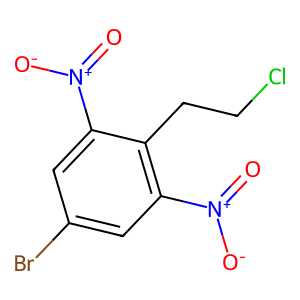
Benzene, 5-bromo-2-(2-chloroethyl)-1,3-dinitro-
Names and Identifiers of 1000343-31-6
CAS Number |
1000343-31-6 |
|---|---|
IUPAC Name |
5-bromanyl-2-(2-chloroethyl)-1,3-dinitro-benzene |
Canonical SMILES |
C1=C(C=C(C(=C1[N+](=O)[O-])CCCl)[N+](=O)[O-])Br |
Physical and chemical properties of 1000343-31-6
Exact Mass |
307.92000 |
|---|---|
LogP |
4.09320 |
Molecular Formula |
C8H6BrClN2O4 |
Molecular Weight |
309.50100 |
PSA |
91.64000 |
Applications of 1000343-31-6
5-Bromo-2-(2-chloroethyl)-1,3-dinitrobenzene has several applications across various fields:
- Organic Synthesis: It serves as an intermediate in the synthesis of complex organic molecules, particularly in pharmaceuticals and agrochemicals.
- Materials Science: The compound is utilized in the preparation of functional materials like polymers and dyes due to its electron-withdrawing properties.
- Biological Studies: It is used in research related to its biological effects and as a biochemical probe for studying cellular processes.
Interaction Studies of 1000343-31-6
Studies on the interactions of 5-Bromo-2-(2-chloroethyl)-1,3-dinitrobenzene with biological systems have revealed its potential as a lead compound for drug development. Its reactive functional groups allow it to modify biomolecules, which can be crucial for understanding mechanisms of action in pharmacology. Ongoing research aims to explore its effects on specific enzymes and receptors, enhancing our understanding of its therapeutic potential.
Biological Activity of 1000343-31-6
Research indicates that 5-Bromo-2-(2-chloroethyl)-1,3-dinitrobenzene exhibits notable biological activity. The compound's mechanism of action involves interactions with biological molecules, particularly through its reactive functional groups. The reduction of nitro groups can generate reactive intermediates capable of interacting with nucleophilic sites in proteins and DNA. This interaction may lead to inhibition of enzyme activity or disruption of cellular processes, suggesting potential utility in drug development and biochemical studies.