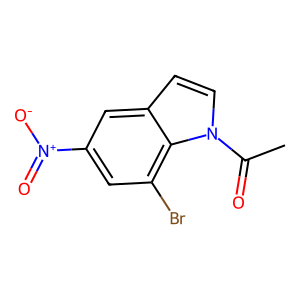
1-(7-Bromo-5-nitro-1H-indol-1-yl)ethanone
CAS No.:
1000343-23-6
M. Wt:
283.078
M. Fa:
C10H7BrN2O3
InChI Key:
XYPVOCFWGOBPPW-UHFFFAOYSA-N
Names and Identifiers of 1000343-23-6
CAS Number |
1000343-23-6 |
|---|---|
IUPAC Name |
1-(7-bromo-5-nitroindol-1-yl)ethanone |
InChI |
InChI=1S/C10H7BrN2O3/c1-6(14)12-3-2-7-4-8(13(15)16)5-9(11)10(7)12/h2-5H,1H3 |
InChIKey |
XYPVOCFWGOBPPW-UHFFFAOYSA-N |
Canonical SMILES |
CC(=O)N1C=CC2=CC(=CC(=C21)Br)[N+](=O)[O-] |
Physical and chemical properties of 1000343-23-6
Boiling Point |
395.2±22.0 °C at 760 mmHg |
|---|---|
Density |
1.8±0.1 g/cm3 |
Exact Mass |
281.963989 |
Flash Point |
192.8±22.3 °C |
Index of Refraction |
1.684 |
LogP |
2.49 |
Molecular Formula |
C10H7BrN2O3 |
Molecular Weight |
283.078 |
PSA |
67.82000 |
Vapour Pressure |
0.0±0.9 mmHg at 25°C |
Applications of 1000343-23-6
The compound has several applications across different fields:
- Chemistry: Serves as a building block for synthesizing more complex molecules.
- Biology: Studied for potential biological activities, including antimicrobial and anticancer effects.
- Medicine: Investigated for drug development targeting specific biological pathways.
- Industry: Utilized in developing dyes, pigments, and other industrial chemicals.
Interaction Studies of 1000343-23-6
The interaction studies involving 1-(7-Bromo-5-nitro-1H-indol-1-yl)ethanone focus on its mechanism of action within biological systems. It may interact with various molecular targets, such as enzymes or receptors, influencing their activity. The presence of both the nitro and bromo groups can enhance its binding affinity and specificity for these targets, potentially leading to significant biological effects.
Biological Activity of 1000343-23-6
The biological activity of 1-(7-Bromo-5-nitro-1H-indol-1-yl)ethanone has been explored in various studies. Indole derivatives, including this compound, are known for their diverse biological effects, such as:
- Antimicrobial Activity: Exhibiting potential against various pathogens.
- Anticancer Properties: Investigated for their ability to inhibit cancer cell growth and induce apoptosis.
- Anti-inflammatory Effects: Some indole derivatives have shown promise in reducing inflammation through inhibition of specific pathways.