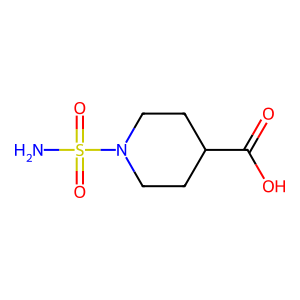
1-Sulfamoylpiperidine-4-carboxylic acid
Names and Identifiers of 1-Sulfamoylpiperidine-4-carboxylic acid
CAS Number |
1000932-67-1 |
|---|---|
EC Number |
850-767-8 |
MDL Number |
MFCD09940510 |
IUPAC Name |
1-sulfamoylpiperidine-4-carboxylic acid |
InChI |
InChI=1S/C6H12N2O4S/c7-13(11,12)8-3-1-5(2-4-8)6(9)10/h5H,1-4H2,(H,9,10)(H2,7,11,12) |
InChIKey |
RHSCFCIWXIKLFP-UHFFFAOYSA-N |
Canonical SMILES |
C1CN(CCC1C(=O)O)S(=O)(=O)N |
UNSPSC Code |
12352100 |
Physical and chemical properties of 1-Sulfamoylpiperidine-4-carboxylic acid
Molecular Formula |
C6H12N2O4S |
|---|---|
Molecular Weight |
208.24 |
Safety Information of 1-Sulfamoylpiperidine-4-carboxylic acid

Applications of 1-Sulfamoylpiperidine-4-carboxylic acid
1-Sulfamoylpiperidine-4-carboxylic acid has potential applications in:
- Pharmaceutical Development: As a lead compound for developing new antibacterial agents or drugs targeting specific biological pathways.
- Research: Used in studies related to enzyme inhibition and drug design due to its unique structural features.
Interaction Studies of 1-Sulfamoylpiperidine-4-carboxylic acid
Interaction studies involving 1-sulfamoylpiperidine-4-carboxylic acid focus on its binding affinity to various biological targets. These studies typically employ techniques such as:
- Molecular Docking: To predict how the compound interacts with target proteins.
- Enzyme Inhibition Assays: To evaluate its effectiveness against specific enzymes, particularly those involved in bacterial metabolism.
Such studies are crucial for understanding the therapeutic potential and mechanism of action of this compound.
Biological Activity of 1-Sulfamoylpiperidine-4-carboxylic acid
The biological activity of 1-sulfamoylpiperidine-4-carboxylic acid is primarily attributed to its structural components. Compounds with sulfamoyl groups are often associated with antibacterial properties due to their ability to inhibit bacterial enzymes such as dihydropteroate synthase. Additionally, the piperidine ring is known to interact with various biological targets, potentially influencing neurotransmitter systems and exhibiting analgesic or anti-inflammatory effects.