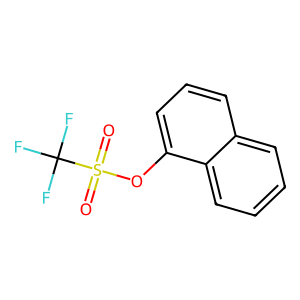
1-Naphthyl trifluoromethanesulfonate
CAS No.:
99747-74-7
M. Wt:
276.23200
M. Fa:
C11H7F3O3S
InChI Key:
WQWUQDVFRYMMCY-UHFFFAOYSA-N
Appearance:
Pale-yellow Liquid
Names and Identifiers of 1-Naphthyl trifluoromethanesulfonate
CAS Number |
99747-74-7 |
|---|---|
EC Number |
623-315-0 |
MDL Number |
MFCD00192340 |
IUPAC Name |
naphthalen-1-yl trifluoromethanesulfonate |
InChI |
InChI=1S/C11H7F3O3S/c12-11(13,14)18(15,16)17-10-7-3-5-8-4-1-2-6-9(8)10/h1-7H |
InChIKey |
WQWUQDVFRYMMCY-UHFFFAOYSA-N |
Canonical SMILES |
C1=CC=C2C(=C1)C=CC=C2OS(=O)(=O)C(F)(F)F |
UNII |
XFN7KQP8Q3 |
UNSPSC Code |
12352100 |
Physical and chemical properties of 1-Naphthyl trifluoromethanesulfonate
Appearance of Characters |
Liquid | Colorless dark red |
|---|---|
Boiling Point |
97-98ºC0.3 mm Hg(lit.) |
Density |
1.405 g/mL at 25ºC(lit.) |
Exact Mass |
276.00700 |
Flash Point |
>230 °F |
Index of Refraction |
n20/D 1.52(lit.) |
LogP |
4.14900 |
Molecular Formula |
C11H7F3O3S |
Molecular Weight |
276.23200 |
PSA |
51.75000 |
Safety Information of 1-Naphthyl trifluoromethanesulfonate

Applications of 1-Naphthyl trifluoromethanesulfonate
1-Naphthyl trifluoromethanesulfonate finds applications across various fields:
- Organic Synthesis: It is widely used in the synthesis of complex organic molecules through arylation reactions.
- Pharmaceutical Development: The compound serves as a precursor for biologically active compounds, contributing to drug discovery and development processes.
- Material Science: It may also be utilized in modifying materials to enhance their properties, particularly in electronic applications due to its structural characteristics.
Interaction Studies of 1-Naphthyl trifluoromethanesulfonate
Interaction studies involving 1-naphthyl trifluoromethanesulfonate often focus on its reactivity with different nucleophiles and electrophiles. These studies provide insights into its mechanism of action during arylation processes and highlight how environmental factors such as solvent choice and temperature can influence its reactivity. For instance, research has shown that the nucleophilicity of the triflate group can vary significantly depending on the reaction conditions.
Similar Compounds: Comparison with Other CompoundsSeveral compounds share structural or functional similarities with 1-naphthyl trifluoromethanesulfonate. Here is a comparison highlighting their uniqueness:
| Compound Name | Structure Type | Key Features |
|---|---|---|
| 2-Naphthyl trifluoromethanesulfonate | Aryl sulfonate | Similar reactivity but differs in spatial orientation of naphthyl group. |
| Phenyl trifluoromethanesulfonate | Aryl sulfonate | Less sterically hindered than naphthyl derivatives; used in simpler arylation reactions. |
| Benzyl trifluoromethanesulfonate | Aryl sulfonate | More reactive due to less steric hindrance; often used for rapid coupling reactions. |
| 2-(Trifluoromethylsulfonyloxy)naphthalene | Aryl sulfonate | Contains a trifluoromethyl group enhancing electronic properties; useful in specialized applications. |
Physical sample testing spectrum (NMR) of 1-Naphthyl trifluoromethanesulfonate

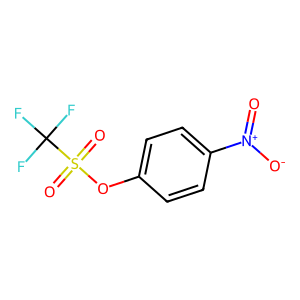 Cas:17763-80-3

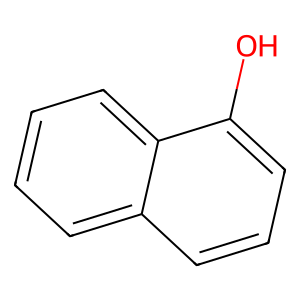 Cas:90-15-3

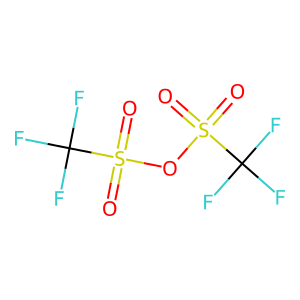 Cas:358-23-6