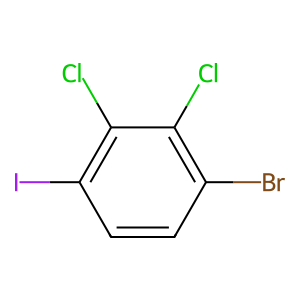
1-Bromo-2,3-dichloro-4-iodobenzene
Names and Identifiers of 1-Bromo-2,3-dichloro-4-iodobenzene
CAS Number |
1000574-05-9 |
|---|---|
MDL Number |
MFCD09878189 |
IUPAC Name |
1-bromo-2,3-dichloro-4-iodobenzene |
InChI |
InChI=1S/C6H2BrCl2I/c7-3-1-2-4(10)6(9)5(3)8/h1-2H |
InChIKey |
QLCWCMZDBOFHSG-UHFFFAOYSA-N |
Canonical SMILES |
C1=CC(=C(C(=C1Br)Cl)Cl)I |
UNSPSC Code |
12352100 |
Physical and chemical properties of 1-Bromo-2,3-dichloro-4-iodobenzene
Boiling Point |
320.0±37.0 °C at 760 mmHg |
|---|---|
Density |
2.3±0.1 g/cm3 |
Exact Mass |
349.776154 |
Flash Point |
147.4±26.5 °C |
Index of Refraction |
1.670 |
LogP |
4.68 |
Melting Point |
89 to 91°C |
Molecular Formula |
C6H2BrCl2I |
Molecular Weight |
351.795 |
Vapour Pressure |
0.0±0.7 mmHg at 25°C |
Safety Information of 1-Bromo-2,3-dichloro-4-iodobenzene

Applications of 1-Bromo-2,3-dichloro-4-iodobenzene
1-Bromo-2,3-dichloro-4-iodobenzene serves various purposes in research and industry:
- Organic Synthesis: It is a valuable building block in synthetic organic chemistry, particularly for creating complex molecules through cross-coupling reactions.
- Biological Research: The compound is used in synthesizing biologically active molecules that may have pharmaceutical applications.
- Industrial Uses: It acts as an intermediate in producing agrochemicals, dyes, and other industrial chemicals.
Interaction Studies of 1-Bromo-2,3-dichloro-4-iodobenzene
Studies on the interactions of 1-Bromo-2,3-dichloro-4-iodobenzene with different nucleophiles and electrophiles are crucial for understanding its reactivity. The presence of multiple halogen substituents enhances its electrophilicity, making it a suitable candidate for various nucleophilic substitution reactions. Additionally, its ability to undergo coupling reactions expands its utility in synthesizing complex organic structures.
Biological Activity of 1-Bromo-2,3-dichloro-4-iodobenzene
Research indicates that halogenated aromatic compounds like 1-Bromo-2,3-dichloro-4-iodobenzene exhibit various biological activities. These compounds can interact with biological systems, potentially leading to pharmacological effects. The specific biological activities of this compound are still under investigation, but similar halogenated compounds have been studied for their antimicrobial and anticancer properties.