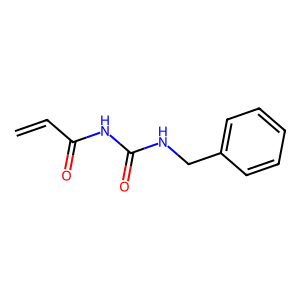
1-Benzyl-3-(prop-2-enoyl)urea
CAS No.:
1000931-67-8
M. Wt:
204.22
M. Fa:
C11H12N2O2
InChI Key:
NPIUYHJLQXOYFZ-UHFFFAOYSA-N
Names and Identifiers of 1-Benzyl-3-(prop-2-enoyl)urea
CAS Number |
1000931-67-8 |
|---|---|
EC Number |
985-465-6 |
IUPAC Name |
N-(benzylcarbamoyl)prop-2-enamide |
InChI |
InChI=1S/C11H12N2O2/c1-2-10(14)13-11(15)12-8-9-6-4-3-5-7-9/h2-7H,1,8H2,(H2,12,13,14,15) |
InChIKey |
NPIUYHJLQXOYFZ-UHFFFAOYSA-N |
Canonical SMILES |
C=CC(=O)NC(=O)NCC1=CC=CC=C1 |
Physical and chemical properties of 1-Benzyl-3-(prop-2-enoyl)urea
Molecular Formula |
C11H12N2O2 |
|---|---|
Molecular Weight |
204.22 |
Safety Information of 1-Benzyl-3-(prop-2-enoyl)urea

Applications of 1-Benzyl-3-(prop-2-enoyl)urea
1-Benzyl-3-(prop-2-enoyl)urea has potential applications in various fields:
- Pharmaceuticals: Due to its biological activity, it may serve as a lead compound for developing new analgesics or anti-inflammatory drugs.
- Agricultural Chemistry: It could be explored for use in agrochemicals due to its potential effects on plant growth or pest resistance.
Biological Activity of 1-Benzyl-3-(prop-2-enoyl)urea
Research indicates that compounds related to 1-benzyl-3-(prop-2-enoyl)urea exhibit significant biological activities. For instance, derivatives of urea have shown promise in anti-inflammatory and analgesic properties. Specific studies have highlighted their potential in treating pain through nociceptive pathways, suggesting that this compound may also possess similar pharmacological effects.