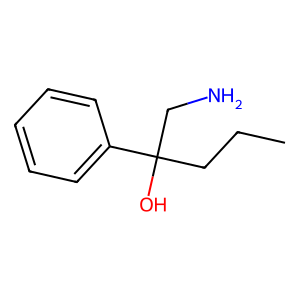
1-Amino-2-phenylpentan-2-ol
Names and Identifiers of 1-Amino-2-phenylpentan-2-ol
CAS Number |
100054-37-3 |
|---|---|
MDL Number |
MFCD17219198 |
IUPAC Name |
1-amino-2-phenylpentan-2-ol |
InChI |
InChI=1S/C11H17NO/c1-2-8-11(13,9-12)10-6-4-3-5-7-10/h3-7,13H,2,8-9,12H2,1H3 |
InChIKey |
CUQIXSHMVVABAI-UHFFFAOYSA-N |
Canonical SMILES |
CCCC(CN)(C1=CC=CC=C1)O |
UNSPSC Code |
12352100 |
Physical and chemical properties of 1-Amino-2-phenylpentan-2-ol
Exact Mass |
179.13100 |
|---|---|
H Bond Acceptors |
2 |
H Bond Donors |
2 |
LogP |
2.33330 |
Molecular Formula |
C11H17NO |
Molecular Weight |
179.25900 |
PSA |
46.25000 |
Safety Information of 1-Amino-2-phenylpentan-2-ol

Applications of 1-Amino-2-phenylpentan-2-ol
1-Amino-2-phenylpentan-2-ol has several applications:
- Pharmaceutical Development: Its role as a β-secretase inhibitor positions it as a candidate for drugs targeting Alzheimer's disease.
- Chemical Research: It serves as a building block in organic synthesis and medicinal chemistry for developing new therapeutic agents.
Interaction Studies of 1-Amino-2-phenylpentan-2-ol
Studies investigating the interactions of 1-Amino-2-phenylpentan-2-ol with biological targets have highlighted its potential as a selective inhibitor of β-secretase enzymes. The presence of specific substituents on the phenyl ring enhances binding affinity and selectivity towards these enzymes, making it a focus of research in neuropharmacology.
Biological Activity of 1-Amino-2-phenylpentan-2-ol
Research indicates that 1-Amino-2-phenylpentan-2-ol exhibits potential biological activity, particularly as an inhibitor of β-secretase enzymes, which are implicated in Alzheimer's disease. In studies, derivatives of this compound have shown selective inhibition of human β-secretase 1 and 2, suggesting its relevance in neurodegenerative disease research. Additionally, its structural properties may contribute to interactions with various biological targets.