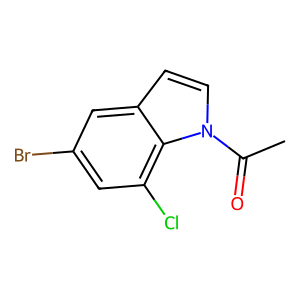
1-ACETYL-5-BROMO-7-CHLOROINDOLE
CAS No.:
1000343-44-1
M. Wt:
272.526
M. Fa:
C10H7BrClNO
InChI Key:
YWWFHTIPZJKUAY-UHFFFAOYSA-N
Names and Identifiers of 1-ACETYL-5-BROMO-7-CHLOROINDOLE
CAS Number |
1000343-44-1 |
|---|---|
MDL Number |
MFCD09880071 |
IUPAC Name |
1-(5-bromo-7-chloro-1H-indol-1-yl)ethan-1-one |
InChI |
InChI=1S/C10H7BrClNO/c1-6(14)13-3-2-7-4-8(11)5-9(12)10(7)13/h2-5H,1H3 |
InChIKey |
YWWFHTIPZJKUAY-UHFFFAOYSA-N |
Canonical SMILES |
CC(=O)N1C=CC2=CC(Br)=CC(Cl)=C21 |
UNSPSC Code |
12352100 |
Physical and chemical properties of 1-ACETYL-5-BROMO-7-CHLOROINDOLE
Boiling Point |
350.1±22.0 °C at 760 mmHg |
|---|---|
Density |
1.6±0.1 g/cm3 |
Exact Mass |
270.939941 |
Flash Point |
165.6±22.3 °C |
H Bond Acceptors |
1 |
H Bond Donors |
0 |
Index of Refraction |
1.649 |
LogP |
3.50 |
Molecular Formula |
C10H7BrClNO |
Molecular Weight |
272.526 |
PSA |
22.00000 |
Storage condition |
2-8°C |
Vapour Pressure |
0.0±0.8 mmHg at 25°C |
Safety Information of 1-ACETYL-5-BROMO-7-CHLOROINDOLE

Applications of 1-ACETYL-5-BROMO-7-CHLOROINDOLE
The applications of 1-(5-Bromo-7-chloro-1H-indol-1-yl)ethanone are diverse:
- Research Tool: It serves as a valuable compound in biochemical research for studying enzyme interactions and cellular processes.
- Potential Drug Development: Its biological activities suggest potential applications in drug development, particularly for anticancer therapies.
Interaction Studies of 1-ACETYL-5-BROMO-7-CHLOROINDOLE
Studies on the interactions of 1-(5-Bromo-7-chloro-1H-indol-1-yl)ethanone with various biomolecules have revealed significant insights into its mechanism of action:
- Binding Studies: The compound has been shown to bind to specific enzymes and receptors, influencing their activity.
- Temporal Effects: The stability and degradation of this compound over time can affect its long-term impact on cellular functions, highlighting the importance of studying its interactions under varying conditions.
Biological Activity of 1-ACETYL-5-BROMO-7-CHLOROINDOLE
The biological activity of 1-(5-Bromo-7-chloro-1H-indol-1-yl)ethanone has been a subject of interest due to its potential effects on various cellular processes:
- Enzyme Inhibition: This compound has been shown to inhibit enzymes involved in cancer cell proliferation, suggesting its potential as an anticancer agent.
- Cellular Effects: It influences cell signaling pathways, gene expression, and cellular metabolism, demonstrating its capability to affect different types of cells and their functions.
- Molecular Mechanism: The compound interacts with specific biomolecules, leading to either inhibition or activation of their functions, which is crucial for understanding its therapeutic potential.